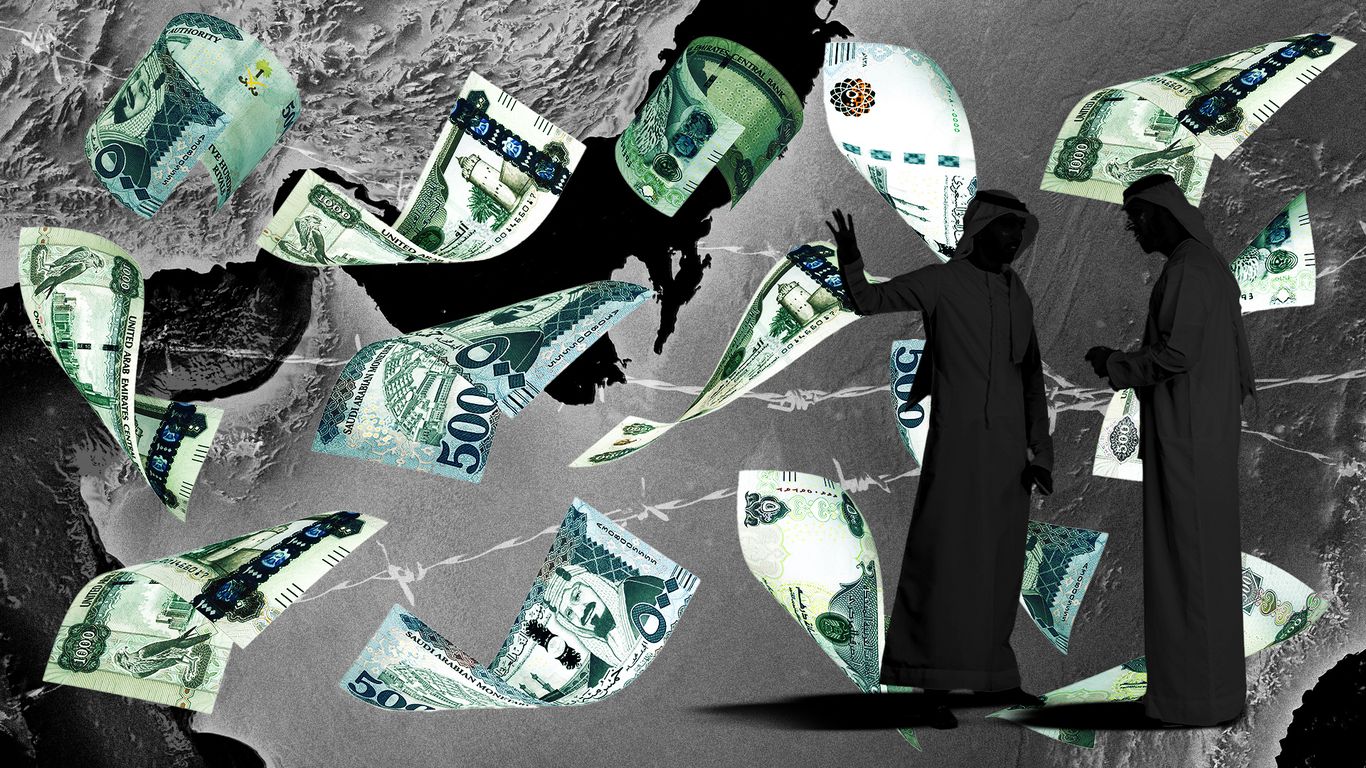
The year that shook the Gulf
```json { "title": "Gulf Investment Crisis: UAE Exits OPEC, Saudi Arabia Ends LIV Golf", "metaDescription": "The UAE left OPEC on May 1, 2026, after 58 years. Saudi Arabia is ending LIV Golf funding. Here's what it means for Gulf AI ambitions and Trump's $2T deals.", "content": "<h2>Gulf Investment Vision Takes Major Blow as UAE Quits OPEC and Saudi Arabia Retreats from LIV Golf</h2>\n\n<p>In the span of just four days, two of the Gulf's most consequential economic signals fired in quick succession. On April 28, 2026, the United Arab Emirates announced it would formally exit OPEC and OPEC+ — ending nearly 58 years of membership in the cartel — effective May 1. One day later, Saudi Arabia's Public Investment Fund (PIF) confirmed it would cease funding LIV Golf after the 2026 season. Together, these decisions reflect a Gulf region under severe strain: from an escalating conflict with Iran, a deepening Saudi-UAE rivalry, and growing questions about the future of the trillion-dollar investment pledges that President Trump secured during his May 2025 tour of the region.</p>\n\n<h2>The UAE's OPEC Exit: What Happened and Why It Matters</h2>\n\n<p>The UAE's departure from OPEC, effective May 1, 2026, is one of the most significant ruptures in the cartel's history. The UAE was the third-largest oil producer in OPEC behind Saudi Arabia and Iraq at the time of its exit, and its departure removes a major source of spare capacity from the group's framework. OPEC+ currently accounts for approximately 41 percent of global oil supply through its arrangement with non-OPEC partner nations.</p>\n\n<p>UAE Energy Minister Suhail Mohamed al-Mazrouei offered a measured but pointed explanation. <strong>"This is a policy decision. It has been done after a careful look at current and future policies related to level of production,"</strong> he said, according to Al Jazeera and Reuters. Notably, al-Mazrouei confirmed the UAE did not raise the issue with any other country beforehand — a pointed signal of how far the relationship between Abu Dhabi and Riyadh has deteriorated.</p>\n\n<p>The UAE has been pressing for the right to expand its own production capacity, targeting 4.8 to 5 million barrels per day by 2027. That ambition has long been a source of friction with Saudi Arabia, which has sought to manage output levels to stabilize prices. The UAE's exit removes any formal constraint on that expansion.</p>\n\n<p>Saudi Arabia's former senior oil adviser, Mohammad al-Sabban, downplayed the impact. <strong>"It's not a major blow, especially for OPEC+ [which] consists of 23 countries, and one country going out doesn't mean anything,"</strong> he told Al Jazeera. But energy analysts were less sanguine. David Goldwyn, who served as the U.S. State Department's special envoy and coordinator for international energy affairs from 2009 to 2011, warned on CNBC: <strong>"There's significant risk of higher oil price volatility as a result of this decision."</strong></p>\n\n<p>Rystad Energy, in comments attributed to an unnamed spokesperson in an Al Jazeera report, put it plainly: <strong>"Saudi Arabia is now left doing more of the heavy lifting on price stability, and the market loses one of the few shock absorbers it had left."</strong></p>\n\n<p>The timing is particularly consequential given the Strait of Hormuz crisis. Since early March 2026, tanker traffic through the strait has dropped to well below 10 percent of normal volumes amid the ongoing US-Israel-Iran conflict. Saudi Arabia and the UAE together control a majority of the world's total spare oil production capacity of more than 4 million barrels per day — but that capacity means little if the primary export route remains disrupted.</p>\n\n<h2>LIV Golf Shutdown Signals PIF's Strategic Retrenchment</h2>\n\n<p>Saudi Arabia's decision to end funding for LIV Golf after the 2026 season, confirmed publicly on April 29, 2026, closes the chapter on one of the Gulf's most visible — and costly — forays into Western soft power. According to the Wall Street Journal, as cited by CBS Sports and Sky Sports, Saudi Arabia invested more than $5 billion into LIV Golf since the league's launch in June 2022. Annual losses were running at an estimated $500 million to $600 million per year.</p>\n\n<p>PIF's official statement was direct: <strong>"PIF has made the decision to fund LIV Golf only for the remainder of the 2026 season."</strong> A second statement explained the reasoning: <strong>"The substantial investment required by LIV Golf over a longer term is no longer consistent with the current phase of PIF's investment strategy."</strong></p>\n\n<p>That shift in strategy extends well beyond golf. In April 2026, PIF Governor Yasir Al-Rumayyan announced that international investments by the fund would be cut from 30 percent to 20 percent of its total portfolio as part of a new five-year strategic investment plan. That retrenchment has direct implications for the sweeping US-Gulf investment architecture that Trump celebrated as a signature achievement of his second term.</p>\n\n<h2>Trump's $2 Trillion Gulf Deals: The Gap Between Announcement and Reality</h2>\n\n<p>During his May 2025 Gulf tour — the first major overseas trip of his second term — President Trump announced over $2 trillion in total investment commitments: $600 billion from Saudi Arabia, $1.2 trillion from Qatar, and $200 billion in new commercial deals from the UAE. The UAE had separately declared in March 2025 that it would invest $1.4 trillion in the United States over the next decade. Major technology deals included Nvidia partnering with Humain, a PIF-backed Saudi AI startup, shipping 18,000 Blackwell GB300 chips immediately, while the UAE was approved to import up to 500,000 of Nvidia's most advanced AI chips annually from 2025 through 2027.</p>\n\n<p>The headline figures were always contested. The Washington Institute for Near East Policy estimated the total real value of the deals at around $730 billion, noting that many were already in progress under the previous administration and that others were based on nonbinding pledges. That skepticism now looks prescient.</p>\n\n<p>Gulf sovereign wealth funds from Saudi Arabia, Qatar, and the UAE pledged $24 billion to back the Paramount-Skydance and Warner Bros. Discovery merger deal announced on February 27, 2026. The following day, the US-Israel war on Iran broke out, and those same funds began a sweeping review of their American investments, according to Drop Site News.</p>\n\n<h2>Iran War Disrupts Gulf AI Ambitions and Data Infrastructure</h2>\n\n<p>The Gulf's post-oil vision was built on three pillars: tourism, AI infrastructure, and American capital. All three are now under pressure. Iran retaliated against Gulf Cooperation Council countries with approximately 83 percent of its total missile and drone strikes during the conflict, with the UAE receiving the most attacks of any country — including Israel — according to the Atlantic Council. Iranian drone attacks struck data centers in the UAE and Bahrain, disrupting critical cloud infrastructure.</p>\n\n<p>Ginger Matchett, a geostrategist at the Atlantic Council, captured the stakes clearly: <strong>"The war is leaving data center investment up in the air."</strong></p>\n\n<p>The blow lands at a particularly sensitive moment. Technology spending by Middle East countries was projected to reach $155 billion in 2025, with $9.5 billion allocated to data center investments — a nearly 70 percent jump from the prior year, according to Gartner as cited by CNN. A PwC analysis estimated that AI could add more than $15 trillion to the global economy by 2030, with $320 billion of that in the Middle East, and AI contributions of more than 12 percent of GDP for Saudi Arabia and 14 percent for the UAE. Those projections were modeled on stability, not conflict.</p>\n\n<p>By 2026, both Saudi Arabia and the UAE had climbed into the top ten global destinations for foreign direct investment, compared to not being in the top twenty just a decade earlier, according to Kearney's annual survey as cited by the Council on Foreign Relations. The speed of that ascent was remarkable. So is the speed at which the conditions enabling it are now being tested.</p>\n\n<h2>The Saudi-UAE Rift: From Yemen to OPEC</h2>\n\n<p>The public breaks of late April and early May 2026 are the culmination of tensions that have been building since at least late 2025. On December 30, 2025, Saudi Arabia conducted airstrikes on the port city of Mukalla targeting what it said was a UAE-linked weapons shipment. Yemen's internationally recognized government subsequently ordered all UAE troops to withdraw within 24 hours. On January 9, 2026, the UAE-backed Southern Transitional Council in Yemen announced its dissolution following rapid territorial losses after Saudi-backed government forces launched a counteroffensive.</p>\n\n<p>According to Chatham House, the US-Israel war against Iran has presented major challenges for Saudi Arabia, including the Strait of Hormuz closure, a deepening rift with the UAE, and the UAE's OPEC exit — each compounding the others.</p>\n\n<p>Gregory Gause III, associate fellow at the Middle East Institute, offered two overlapping explanations for the UAE's OPEC move. <strong>"It seems that the war might have exacerbated the differences that the Emirates felt,"</strong> he told Al Jazeera. But he also framed it as a longer-term strategic calculation: <strong>"The UAE is preparing for a world after the Iran war where oil demand is in decline, and OPEC's power to maintain control and discipline will be weaker."</strong></p>\n\n<h2>What Comes Next</h2>\n\n<p>The immediate picture is one of compounding uncertainty. The Strait of Hormuz remains severely disrupted, with tanker traffic at well below 10 percent of normal volumes. PIF is reducing its international investment footprint. Gulf sovereign wealth funds are reviewing their American commitments. Data center infrastructure in the UAE has been physically damaged. And OPEC has lost its third-largest producer — one that holds ambitions to expand output significantly — at precisely the moment when the cartel needs cohesion most.</p>\n\n<p>Whether the multitrillion-dollar investment pledges that Trump announced in May 2025 survive this period of turbulence largely depends on how quickly the Iran conflict is resolved and whether the Saudi-UAE relationship can be stabilized. Neither question has a clear answer as of May 2, 2026.</p>\n\n<p>What is clear is that the Gulf's vision of a geopolitically stable, AI-powered, post-oil future — one that would anchor American tech investment and reshape global energy markets simultaneously — is facing its most serious stress test since it was articulated. The gap between announcement and implementation, always the real measure of these deals, has rarely looked wider.</p>\n\n<p>For more tech news, visit our <a href=\"/news\">news section</a>.</p>\n\n<h2>Why This Matters for Your Productivity and Focus</h2>\n\n<p>Global AI infrastructure disruptions, energy price volatility, and shifting investment flows are not abstract geopolitical events — they shape the cost, availability, and reliability of the cloud tools, AI assistants, and productivity platforms that millions of people rely on every day. Understanding the macro forces affecting the technology you use is part of staying sharp in a fast-moving world. At Moccet, we track the developments that matter most to your health, focus, and performance. <a href=\"/#waitlist\">Join the Moccet waitlist to stay ahead of the curve.</a></p>", "excerpt": "The UAE formally exited OPEC on May 1, 2026, after nearly 58 years of membership, while Saudi Arabia announced it would end funding of LIV Golf after the 2026 season. Together, the moves reflect a deepening Saudi-UAE rivalry, the disruptive impact of the ongoing US-Israel-Iran conflict, and mounting uncertainty over the $2 trillion in Gulf investment pledges secured by President Trump in May 2025.", "keywords": ["UAE OPEC exit", "Gulf investment 2026", "LIV Golf Saudi Arabia", "Gulf AI ambitions", "Saudi UAE rift"], "slug": "uae-exits-opec-saudi-arabia-ends-liv-golf-gulf-investment-crisis-2026" } ```