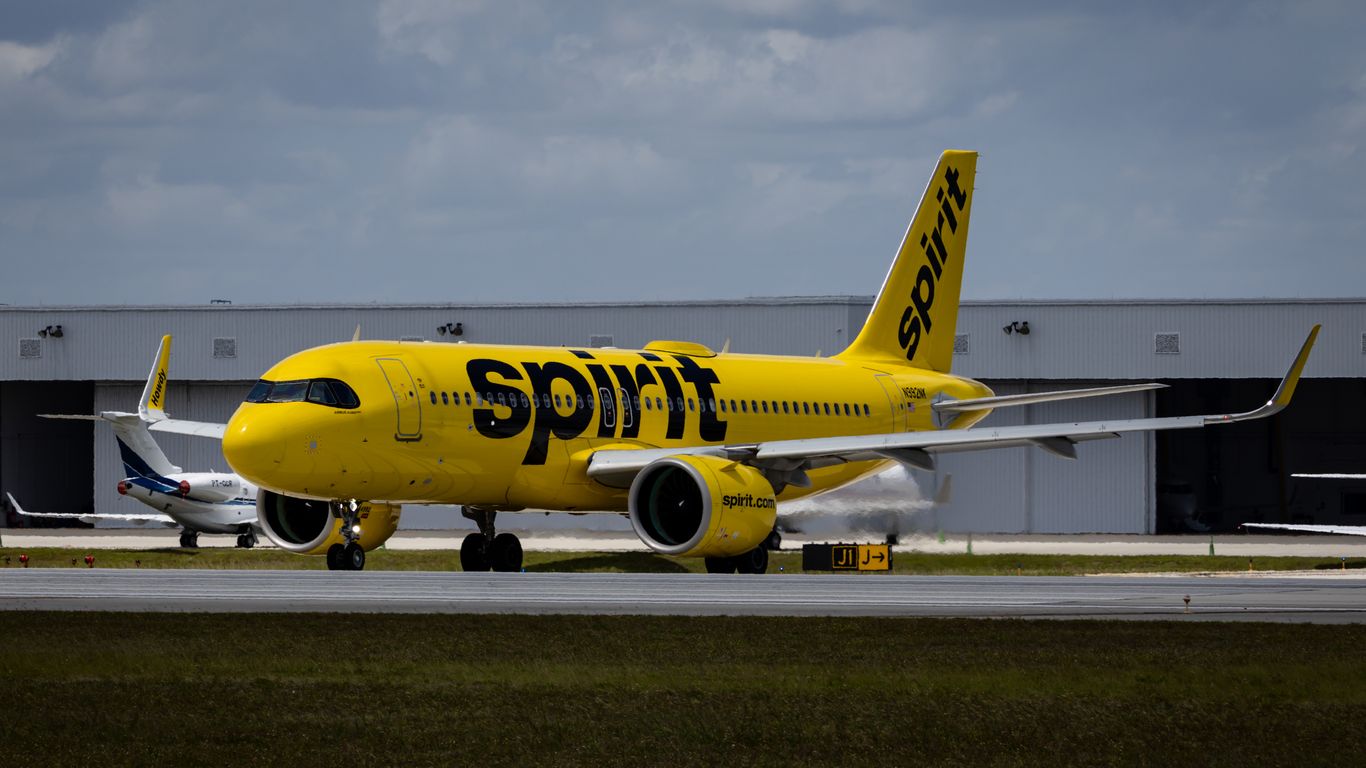
Spirit Airlines shuts down after two bankruptcies and a failed rescue plan
```json { "title": "Spirit Airlines Shuts Down After Failed Government Bailout", "metaDescription": "Spirit Airlines ceased all operations on May 2, 2026, after a $500M federal bailout collapsed. The first major U.S. airline shutdown since 9/11 explained.", "content": "<h2>Spirit Airlines Shuts Down: The End of America's Biggest Budget Carrier</h2><p>Spirit Airlines ceased all operations on May 2, 2026, canceling every flight and stranding passengers across the country after a last-ditch $500 million federal government rescue package fell apart. The airline — which employed approximately 17,000 people and served as the largest ultra-low-cost carrier in North America — halted flying at 3 a.m. ET on Saturday, marking the first shutdown of a significant U.S. airline since Midway Airlines collapsed in the immediate aftermath of the September 11, 2001 attacks.</p><p>In an official statement, the company said: <em>"It is with great disappointment that on May 2, 2026, Spirit Airlines started an orderly wind-down of our operations, effective immediately."</em></p><p>The collapse closes the chapter on a carrier that spent 34 years reshaping how Americans bought airline tickets — and leaves millions of budget travelers, 17,000 workers, and the broader domestic air travel market to reckon with the fallout.</p><h2>What Killed Spirit Airlines: Two Bankruptcies, a Blocked Merger, and a Fuel Price Shock</h2><p>Spirit's demise was not a single catastrophic event but the cumulative result of years of financial erosion, failed strategic moves, and a final blow from surging fuel costs.</p><p>The airline had lost more than $2.5 billion since the start of 2020, never fully recovering its financial footing after the pandemic reshaped travel demand and passenger preferences. In the first two months of 2026 alone — before jet fuel prices reached new records — Spirit lost $60 million.</p><p>Spirit filed for Chapter 11 bankruptcy in November 2024, then filed a second Chapter 11 on August 29, 2025. Its restructuring plan, filed March 13, 2026, was built around an ambitious but fragile set of assumptions: the plan aimed to reduce total debt and aircraft lease commitments from approximately $7.4 billion to around $2.1 billion — a reduction of more than $5 billion — and projected jet fuel costs of $2.24 per gallon for 2026.</p><p>That assumption proved fatal. A conflict involving Iran disrupted global oil supplies, sending U.S. jet fuel prices surging approximately 70 percent above pre-war levels. According to J.P. Morgan estimates, at $4.60 per gallon, Spirit's projected operating margin for fiscal year 2026 could deteriorate to approximately negative 20 percent. The restructuring plan was effectively rendered unviable before it could take hold.</p><p>CEO Dave Davis acknowledged the role of fuel costs directly. <em>"The sudden and sustained rise in fuel prices in recent weeks ultimately has left us with no alternative but to pursue an orderly wind-down of the Company,"</em> Davis said in a statement.</p><p>Spirit's troubles extended well beyond fuel. A proposed $3.8 billion acquisition by JetBlue was blocked after the U.S. Justice Department sued to prevent the deal on competitive grounds, and a federal judge agreed. That rejection left Spirit without a lifeline and without a credible path to independence. Earlier attempts to merge with Frontier Airlines had also failed.</p><p>By February 2026, Spirit held just 3.9% of U.S. passenger market share, according to aviation analytics company Cirium — down from 5.1% in the same month the prior year. Its market share was projected to fall further to 1.8% in May 2026, which would have ranked it ninth among U.S. carriers.</p><h2>The Failed Government Bailout and the Final Days</h2><p>In the weeks leading up to the shutdown, Spirit entered negotiations with the Trump administration over a $500 million rescue package that represented its last viable option. The proposed deal would have given the federal government control of the overwhelming majority of Spirit's shares in exchange for the financial lifeline.</p><p>President Trump publicly acknowledged the negotiations on Friday, May 1, 2026, but signaled uncertainty about the outcome. Speaking to reporters, Trump said: <em>"Well, we're looking at it — but if we can't make a good deal, no institution's been able to do it."</em></p><p>The deal ultimately collapsed after a key group of creditors rejected its terms. With no agreement in place and cash reserves exhausted, Spirit announced the wind-down hours later.</p><p>The airline's final public statement carried a note of institutional pride alongside the announcement of its closure: <em>"We are proud of the impact of our ultra-low-cost model on the industry over the last 34 years and had hoped to serve our Guests for many years to come."</em></p><p>For passengers holding Spirit tickets, the path to refunds is uneven. The airline said it would automatically issue refunds to customers who booked through Spirit using a credit or debit card. However, customers who paid using vouchers, credits, or Free Spirit loyalty points may not receive refunds until the matter is resolved through bankruptcy court. American, United, and Frontier Airlines all announced they were prepared to support displaced Spirit passengers.</p><h2>Why Spirit's Shutdown Matters for Air Travel and Consumers</h2><p>Spirit's exit from the market is not just a corporate bankruptcy story — it has direct implications for the price of flying in the United States.</p><p>Four major carriers — United, American, Delta, and Southwest — currently control approximately 80% of flights available to U.S. passengers. Spirit, despite its small and shrinking market share, functioned as a competitive pressure on those carriers' pricing. William McGee, senior fellow at the American Economic Liberties Project, explained the dynamic clearly: <em>"You do not have to fly a small carrier in order to benefit from its presence, because they will bring down the big guys' fares."</em></p><p>With Spirit gone, that downward pricing pressure disappears on many routes the carrier served, particularly in markets where budget travelers had few alternatives.</p><p>Spirit's collapse also raises questions about the viability of the ultra-low-cost model in the current environment. The airline pioneered the unbundled fare approach in the U.S. — charging rock-bottom base prices while adding fees for everything from carry-on bags to seat selection — but larger carriers gradually adopted their own stripped-down basic economy tiers, eroding Spirit's key competitive advantage.</p><p>Shye Gilad, a former airline pilot and professor at Georgetown University's McDonough School of Business, put it plainly: <em>"When you're a low-cost carrier, by definition, you're relying on having a cost advantage. And they just don't have that anymore."</em></p><p>Mike Boyd, CEO of Boyd Group International, an aviation forecasting company, offered a similarly stark assessment of Spirit's trajectory: <em>"They've just declined to the point now where they'll have to shrink to survive. And no airline can shrink to survive."</em></p><h2>What Comes Next</h2><p>With Spirit's wind-down underway, the immediate priorities are clear: the airline's roughly 17,000 employees and contractors are out of work, and passengers holding unused tickets face an uncertain refund process through bankruptcy court for non-card purchases.</p><p>The bankruptcy proceedings will determine how Spirit's remaining assets — including its aircraft fleet and route certificates — are distributed among creditors. Whether any of those assets are acquired by competing carriers, and which routes may eventually be absorbed by other airlines, will unfold over the coming months through the court process.</p><p>For the broader industry, Spirit's failure is a signal worth watching. The airline's collapse — driven by a combination of structural financial weakness, failed consolidation attempts, shifting consumer preferences, and an exogenous fuel price shock — illustrates the compounding risks facing carriers operating on thin margins with limited financial resilience.</p><p>For now, budget travelers who relied on Spirit's routes will need to look elsewhere, and industry observers will be watching whether the absence of the country's largest ultra-low-cost carrier translates into measurable fare increases on the routes it once served.</p><p>For more tech news, visit our <a href=\"/news\">news section</a>.</p>", "excerpt": "Spirit Airlines ceased all operations on May 2, 2026, halting flights at 3 a.m. ET after a $500 million federal government rescue package collapsed when a key group of creditors rejected its terms. The shutdown — the first of a significant U.S. airline since Midway Airlines folded after September 11, 2001 — leaves approximately 17,000 employees jobless and millions of passengers scrambling for refunds. Surging jet fuel prices, two Chapter 11 bankruptcies, and a blocked $3.8 billion JetBlue merger all contributed to the carrier's demise.", "keywords": ["Spirit Airlines shutdown", "Spirit Airlines bankruptcy", "budget airline collapse", "ultra-low-cost carrier", "airline industry news 2026"], "slug": "spirit-airlines-shuts-down-failed-government-bailout-2026" } ```