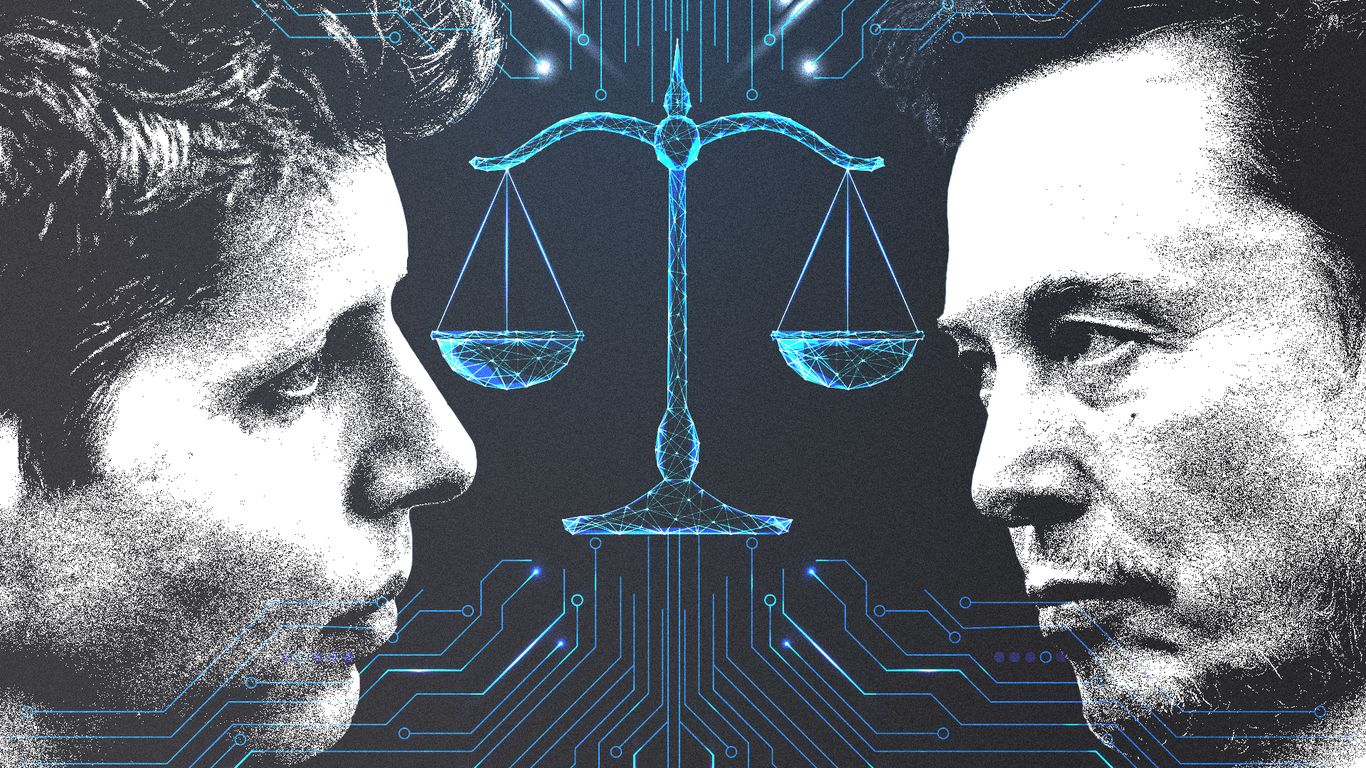
Musk vs. Altman is about what we don't already know
```json { "title": "Musk vs. Altman Trial Begins: What's at Stake for OpenAI", "metaDescription": "The Musk v. Altman trial opened April 28, 2026 in Oakland. Here's what the case means for OpenAI, AI's future, and the $852B company's finances.", "content": "<h2>Musk v. Altman Trial Opens in Oakland as OpenAI Faces Financial Scrutiny</h2><p>The long-anticipated civil trial between Elon Musk and OpenAI CEO Sam Altman got underway on April 28, 2026, in federal court in Oakland, California — with opening arguments beginning the same morning Musk was scheduled to take the witness stand. The case, presided over by U.S. District Judge Yvonne Gonzalez Rogers, centers on two surviving legal claims: unjust enrichment and breach of charitable trust. But the trial's real significance may extend well beyond its formal allegations, as damaging disclosures about OpenAI's finances have already begun rattling markets and raising questions about the company's trajectory ahead of a potential IPO.</p><p>Jury selection concluded on Monday, April 27, 2026, with a nine-person advisory jury seated for the liability phase. Because the case is tried in equity, the jury's verdict is non-binding; Judge Gonzalez Rogers will issue the final ruling. A decision is anticipated by mid-May 2026.</p><h2>What the Trial Is Actually About — and What It Isn't</h2><p>Musk filed his civil lawsuit in 2024, originally asserting 26 claims against Altman, OpenAI President Greg Brockman, and Microsoft — the company's largest corporate backer. By the time the case reached trial, only two claims remained. At its core, Musk alleges that Altman and Brockman deceived him about OpenAI's nonprofit commitment in order to secure his early financial backing, and that the company's restructuring into a for-profit public benefit corporation constitutes a breach of its original charitable mission.</p><p>Musk contributed between $38 million and $44 million to OpenAI in its early years, according to court documents cited by Fox Business and NPR respectively. He departed the board in 2018. OpenAI established a for-profit subsidiary in 2019, and in October 2025 completed a full restructuring into a public benefit corporation — OpenAI Group PBC — overseen by the nonprofit OpenAI Foundation, which retained a 26% equity stake valued at $130 billion. Microsoft ended up with a 27% share valued at $135 billion, and has invested more than $13 billion in OpenAI since 2019. Microsoft is named as a co-defendant, accused of aiding and abetting the breach of charitable trust.</p><p>Musk's lawyers, in a January 2026 filing, stated he should receive up to $134 billion in so-called wrongful gains from OpenAI — though Musk has since asked for those funds to be directed back to OpenAI's nonprofit arm rather than to himself personally. His legal team has also sought the removal of Altman and Brockman from their roles and the unwinding of OpenAI's for-profit conversion.</p><p>California's attorney general declined to join Musk's lawsuit, saying the office did not see how his action serves the public interest, according to MIT Technology Review.</p><h2>Opening Arguments and the Witnesses Who Could Define the Case</h2><p>With Musk confirmed as the first witness on April 28, the trial's early hours carried unusual dramatic weight. In his opening statement, OpenAI's lead attorney William Savitt set a combative tone: <em>"We are here because Mr. Musk didn't get his way at OpenAI. He quit, saying they would fail for sure. But my clients had the nerve to go on and succeed without him. Mr. Musk may not like that, but it's no basis for a lawsuit."</em></p><p>Musk's legal team, for their part, filed court documents describing the alleged conduct in stark terms: <em>"The perfidy and deceit are of Shakespearean proportions."</em></p><p>Judge Gonzalez Rogers ruled ahead of trial that OpenAI's lawyers may question Musk about his attendance at the 2017 Burning Man festival, where critical conversations about restructuring allegedly took place, but barred questions about his alleged ketamine use, according to Fortune.</p><p>Beyond Musk, the witness list reads like a who's-who of the AI industry's most consequential figures. According to MIT Technology Review, expected witnesses include former OpenAI chief scientist Ilya Sutskever, former OpenAI CTO Mira Murati, and Microsoft CEO Satya Nadella. Shivon Zilis — a former OpenAI board member and mother of four of Musk's children — is expected to testify for approximately three hours, according to Fortune.</p><p>During jury selection, Judge Gonzalez Rogers offered a candid observation to counsel: <em>"There are a lot of people out there who don't like your client. And there are plenty who don't like Mr. Altman."</em></p><h2>OpenAI's Finances Under the Microscope</h2><p>The trial's timing has coincided with uncomfortable financial disclosures that have added a separate layer of pressure on OpenAI. The Wall Street Journal reported that the company missed its own internal targets for new users and revenue — including failing to reach its goal of 1 billion weekly active ChatGPT users by the end of 2025. According to court documents cited by NPR, OpenAI currently reports nearly 1 billion weekly active users and a valuation of $852 billion.</p><p>OpenAI reported full-year 2025 revenue of $13.1 billion and monthly revenue of $2 billion at the time of its most recent funding round, according to Yahoo Finance — though the company had not turned a profit. Looking ahead, the company expects to burn through $25 billion in cash in 2026 against a revenue target of $30 billion, according to The Decoder. Bloomberg reported that OpenAI fell short of several monthly sales targets in 2026 after rival Anthropic PBC gained ground in the coding and enterprise markets.</p><p>According to the Wall Street Journal, as reported by Investing.com, OpenAI CFO Sarah Friar warned colleagues that if revenue growth does not accelerate, the company may not be able to pay for future data center contracts. In a joint emailed statement, Altman and Friar pushed back on characterizations of misalignment over spending: <em>"This is ridiculous. We are totally aligned on buying as much compute as we can and working hard on it together every day."</em></p><p>The financial disclosures rattled AI-linked stocks. Shares of SoftBank Group — one of OpenAI's largest investors and an anchor in the company's $122 billion funding round, described as the largest in Silicon Valley history — fell approximately 10% in Asia following the WSJ report. Oracle, which has a $300 billion, five-year partnership to supply computing power to OpenAI, dropped more than 3%.</p><h2>Context: Why This Trial Matters Beyond the Courtroom</h2><p>OpenAI's $122 billion funding round closed at a post-money valuation of $852 billion, anchored by SoftBank, Amazon, and Nvidia. The scale of that capital raise — and the company's ambitions — makes the trial's potential outcomes consequential not just for the two principals, but for the broader AI industry and the investors, partners, and institutions tied to it.</p><p>The two surviving claims — unjust enrichment and breach of charitable trust — may sound narrow, but the remedies Musk is seeking are sweeping. If Judge Gonzalez Rogers were to rule in Musk's favor on the breach of charitable trust claim, it could theoretically unwind or significantly complicate OpenAI's for-profit restructuring, affecting Microsoft's multi-billion-dollar stake, SoftBank's investment, and OpenAI's path to a public offering.</p><p>Meanwhile, Musk's own AI venture, xAI, is a direct competitor to OpenAI. According to MIT Technology Review, xAI in combination with SpaceX is valued at $1.25 trillion and is expected to go public as part of SpaceX as early as June 2026. That context has fueled OpenAI's characterization of the lawsuit as competitive interference. In an official statement posted on X, OpenAI called it: <em>"a baseless and jealous bid to derail a competitor."</em></p><p>OpenAI's restructuring also raises genuine questions about the governance of AI development at scale — questions that were present at the company's founding a decade ago and that the trial will now air in open court. OpenAI was founded in 2015 as a nonprofit with a stated mission of developing artificial intelligence for the benefit of humanity. The evolution from that founding structure to a $852 billion for-profit corporation is precisely what Musk's remaining claims seek to scrutinize.</p><h2>Expert Reactions</h2><p>Tech journalist Casey Newton, founder of the newsletter Platformer, framed the stakes plainly in comments to NPR: <em>"This is a clash of two enormous personalities in Elon Musk and Sam Altman. And I think what is at stake is potentially the future of OpenAI and the future development of all AI."</em></p><p>On the financial disclosures, John Belton, portfolio manager at Gabelli Funds, offered a measured read: <em>"I view the article as largely a rehash of what we already knew: OpenAI's growth seems to have slowed in late-2025 into early-2026 as the business ceded some share to Anthropic and Gemini."</em></p><h2>What Happens Next</h2><p>The trial is structured in two phases. The liability phase — during which the advisory jury will weigh in — is underway. If Musk prevails, the case proceeds to a remedies phase, with Judge Gonzalez Rogers making the final binding ruling. A decision is expected by mid-May 2026.</p><p>Testimony from Satya Nadella, Ilya Sutskever, and Mira Murati is likely to shed new light on the internal dynamics of OpenAI's restructuring, Microsoft's role in it, and the conversations that took place before and after Musk's 2018 departure from the board. Whether any of that testimony produces genuinely new information — or merely reframes what is already known — may matter as much as the legal verdict itself.</p><p>OpenAI's financial pressures, now publicly documented, will continue to be a factor regardless of trial outcomes. The company's ability to close the gap between its $30 billion 2026 revenue target and its $25 billion projected cash burn, while holding off intensifying competition from Anthropic and Google's Gemini, represents a challenge that no court ruling will resolve.</p><p>For more tech news, visit our <a href=\"/news\">news section</a>.</p><h2>The Bigger Picture for How We Work and Think About AI</h2><p>The Musk v. Altman trial is unfolding at a moment when the tools built by both competitors are increasingly embedded in how people work, make decisions, and manage information overload. Understanding who controls these systems, how they are funded, and whether their governance matches their stated missions isn't just a legal or financial question — it's a productivity and wellbeing question for anyone who relies on AI in their daily life. Staying informed about the forces shaping AI's development helps you make smarter choices about which tools to trust and how to use them. <a href=\"/#waitlist\">Join the Moccet waitlist to stay ahead of the curve.</a></p>", "excerpt": "The civil trial between Elon Musk and Sam Altman opened April 28, 2026, in Oakland, California, with Musk taking the stand as the first witness. The case turns on two claims — unjust enrichment and breach of charitable trust — but its implications for OpenAI's $852 billion valuation, its for-profit restructuring, and the broader AI industry are far-reaching. Simultaneous disclosures that OpenAI missed its own internal revenue and user growth targets have added financial pressure to an already high-stakes courtroom battle.", "keywords": ["Musk v. Altman trial", "OpenAI lawsuit", "Elon Musk Sam Altman", "OpenAI for-profit restructuring", "OpenAI revenue targets"], "slug": "musk-vs-altman-trial-openai-2026" } ```