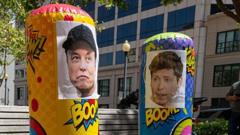
Musk Takes Stand in OpenAI Trial Over Charitable Trust
Elon Musk took the witness stand on April 28, 2026, in a federal courtroom in Oakland, California, casting his lawsuit against OpenAI, CEO Sam Altman, and Microsoft as a defense of the institution of charitable giving itself. The trial — scheduled to run four weeks — marks the culmination of a legal battle that began when Musk filed a federal lawsuit in August 2024 accusing the defendants of breach of charitable trust and unjust enrichment. The outcome could reshape not only the future of OpenAI, now valued at over $850 billion, but the broader legal framework governing how nonprofit organizations can restructure into commercial entities.
Musk on the Stand: 'It's Not Okay to Steal a Charity'
Musk, the first witness called in the trial, framed his case in sweeping moral terms. Testifying before nine advisory jurors and U.S. District Judge Yvonne Gonzalez Rogers, he argued that allowing a nonprofit to convert to a for-profit enterprise — after inducing donations on charitable grounds — would set a dangerous precedent for philanthropic giving across the country.
"It's not okay to steal a charity," Musk said from the stand. "If it's okay to loot a charity, the entire foundation of charitable giving will be destroyed."
Musk says he contributed approximately $38 million to OpenAI during its early years, which he claims represented roughly 60% of the nonprofit's seed funding. He is now seeking $150 billion in damages from OpenAI and Microsoft — a figure his damages expert, financial economist C. Paul Wazzan of Berkeley Research Group, calculated as between $79 billion and $134 billion owed to Musk. Any proceeds from a damages award, Musk has stated, would be directed to OpenAI's charitable arm rather than to himself personally.
Beyond financial damages, Musk is also asking the court to order the firing of Altman and co-founder Greg Brockman and to issue a permanent injunction to preserve OpenAI's original nonprofit charter.
Before jurors were seated, Judge Gonzalez Rogers admonished Musk after OpenAI complained about posts on his social media platform X in which he had referred to Altman as "Scam Altman." The judge warned both parties against using social media to influence the trial.
Opening Statements Draw Battle Lines
The trial's opening statements signaled that both sides intend to fight the case as much on narrative as on law.
Musk's lead trial lawyer, Steven Molo, told jurors that the case was straightforward: "The defendants in the case stole a charity, and we're asking you to hold them accountable." Molo also argued that "without Elon Musk, there would be no OpenAI," invoking Musk's early financial contributions as central to the company's founding and survival.
OpenAI's attorney William Savitt offered a sharply different account. "We are here because Mr. Musk didn't get his way at OpenAI," Savitt told jurors, adding that Musk had "quit, saying they would fail for sure" but that OpenAI had "the nerve to go on and succeed without him."
Among those expected to testify over the course of the four-week trial are OpenAI CEO Sam Altman, Microsoft CEO Satya Nadella, former OpenAI chief scientist Ilya Sutskever, and former OpenAI CTO Mira Murati.
A 2023 email submitted as a trial exhibit added a personal dimension to proceedings. In it, Altman told Musk he is his "hero" but expressed hurt over Musk's attacks on OpenAI. Musk's reply: "the fate of civilization is at stake."
What's Actually on Trial — and What's Already Been Dismissed
Musk originally filed 26 claims in his 2024 lawsuit. Only two survived to trial: breach of charitable trust and unjust enrichment. The narrowing of the case reflects how difficult it has proven to translate Musk's broader grievances into actionable legal claims.
The jury empaneled for the case — nine jurors in total — will deliver an advisory verdict only. Judge Gonzalez Rogers will consider their findings but will ultimately make the liability determination herself.
Microsoft, which has invested more than $13 billion in OpenAI since 2019, is named as a co-defendant. Musk's attorneys argue that Microsoft's investment and partnership activity enabled the alleged breach of charitable trust. Microsoft holds a 27% stake in OpenAI's restructured public benefit corporation, valued at $135 billion under the terms of OpenAI's October 2025 recapitalization.
Context: OpenAI's Transformation from Nonprofit to Near-Trillion-Dollar Company
OpenAI was co-founded in 2015 as a nonprofit research laboratory with a stated mission of developing artificial general intelligence for the benefit of humanity. Musk was among its early backers and board members before departing in 2018 following an internal dispute over control and the company's direction.
A year after Musk's exit, OpenAI created a for-profit subsidiary to attract outside capital — a move Musk argues was a betrayal of the charitable commitments that induced his original donations. In October 2025, OpenAI completed a further "recapitalization," converting its for-profit subsidiary into a public benefit corporation (PBC). Under that structure, OpenAI's nonprofit parent — renamed the OpenAI Foundation — received a 26% stake valued at $130 billion, while Microsoft received a 27% stake valued at $135 billion.
The state attorneys general of California and Delaware separately struck a deal with OpenAI in October 2025 approving its new corporate structure, subject to a series of conditions — including that a safety and security committee at the nonprofit would review safety-related decisions made by the for-profit subsidiary. California's attorney general declined to join Musk's lawsuit, stating the office did not see how the action served the public interest.
OpenAI's for-profit subsidiary is now valued at nearly $1 trillion, according to Fortune, and a potential IPO is anticipated as early as late 2026. Its ChatGPT product has 400 million weekly users, according to figures OpenAI itself has reported.
Legal Experts Express Skepticism About Musk's Standing
Legal scholars specializing in nonprofit law have been broadly skeptical about whether Musk has the legal standing to bring the case at all — noting that enforcement of charitable trusts is typically the province of state attorneys general, not individual donors.
"The idea that Elon Musk can sue because he was a donor or used to be on the board is pretty puzzling," said Jill Horwitz, a law professor specializing in nonprofit law at Northwestern University.
Sam Brunson, a nonprofit law professor at Loyola University Chicago, put the broader principle plainly: "As a general rule, the answer to that is no. If I donate to an organization, I've given up that money, and if it turns out that I don't like what they do subsequently, my recourse is to stop donating to them."
On the question of whether OpenAI's restructuring constituted fraud against Musk specifically, Brunson was equally direct: "Unless they made an explicit promise to him that they would never create a for-profit subsidiary, it's hard to see how he was defrauded."
Geeta Kohli Tewari, a business law professor at Delaware Law School, offered a similar assessment of the legal limits facing donors in nonprofit conversion cases: "Without a binding legal contract, a donor cannot control a nonprofit's choice to convert to a for-profit entity."
What Happens Next — and Why It Matters
The trial is scheduled to run for four weeks in Oakland's federal courthouse, with Altman, Nadella, Sutskever, and Murati all expected to take the stand. Judge Gonzalez Rogers will weigh the advisory jury's verdict before issuing her own ruling on liability.
If Musk prevails on either surviving claim — breach of charitable trust or unjust enrichment — the potential consequences are significant. The court could order that damages flow to OpenAI's charitable arm, require the reinstatement of a nonprofit governance structure, mandate the removal of Altman and Brockman, or issue a permanent injunction to preserve OpenAI's original charter. Any of these outcomes could complicate or derail the company's anticipated IPO.
If OpenAI and Microsoft prevail, the result would effectively ratify the company's decade-long transformation from nonprofit research lab to near-trillion-dollar commercial enterprise — and could influence how other charitable organizations handle future restructurings.
Beyond OpenAI, the case raises unsettled questions about the enforceability of nonprofit charitable commitments in the context of commercial AI development — questions that no court has yet definitively answered at this scale or with these stakes.
For more tech news, visit our news section.
What This Means for You
The OpenAI trial is more than a legal dispute between billionaires — it is a live test of whether the institutions shaping AI development can be held accountable to their founding commitments. The tools that emerge from OpenAI and its competitors increasingly touch how we work, manage our health, and optimize our daily lives. Staying informed about who controls these platforms — and under what obligations — matters for anyone building their productivity or wellness routines around AI-powered technology. Join the Moccet waitlist to stay ahead of the curve.