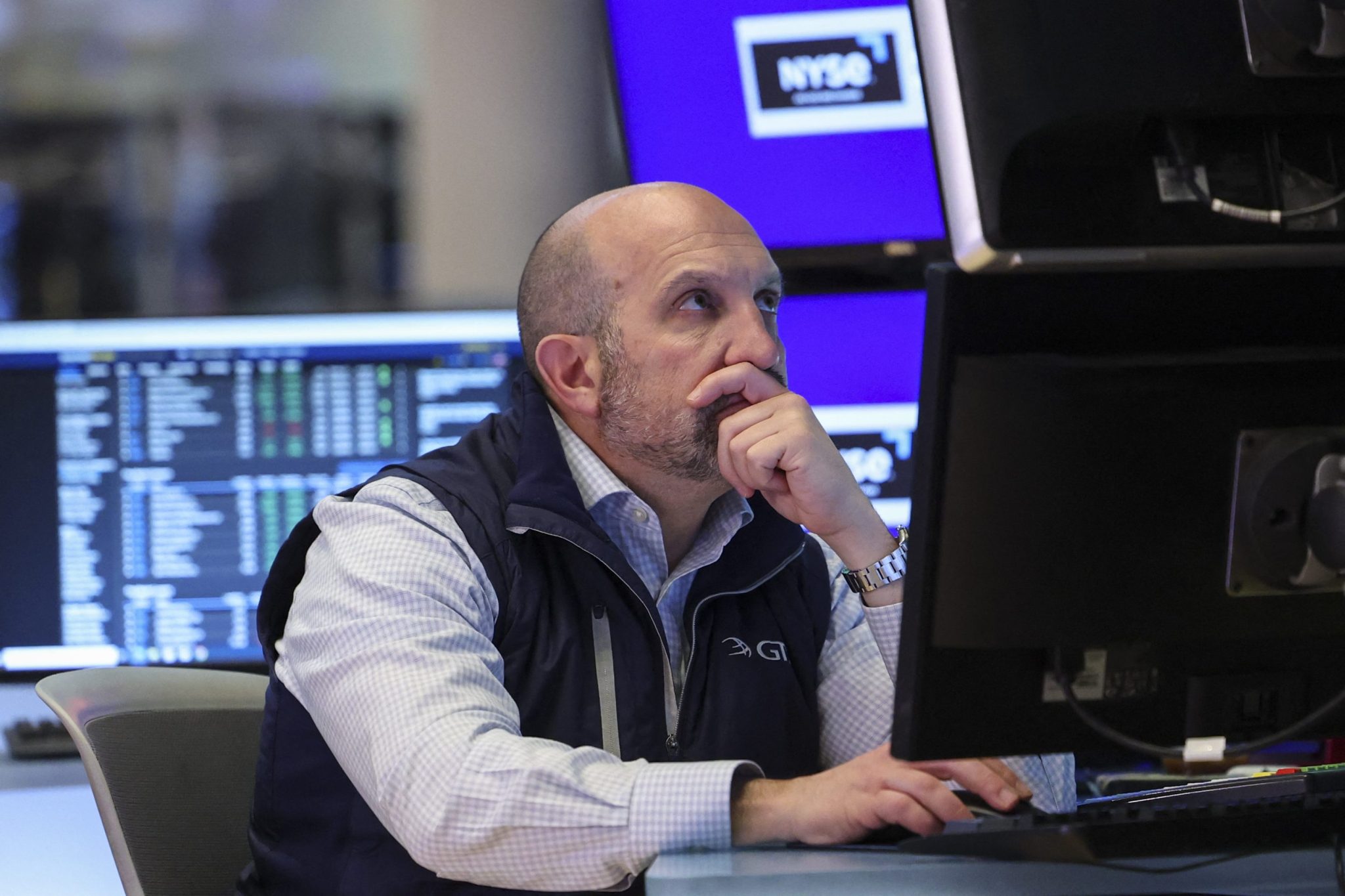
Stocks Fall From Highs as Tesla and Oil Rattle Markets
US Stocks Retreat From Record Highs as Tesla Selloff and Oil Surge Unsettle Wall Street
The US stock market pulled back from record territory on April 23, 2026, as Tesla's post-earnings selloff dragged on major indices and rising oil prices — fueled by escalating tensions in the Strait of Hormuz — compounded investor unease. The S&P 500 fell 0.7%, the Dow Jones Industrial Average dropped 377 points (0.8%), and the Nasdaq composite slid 1.2%, according to BNN Bloomberg. The retreat came just days after the S&P 500 had touched an all-time high of 7,126.06 on April 17.
The dual pressures of a high-spending Tesla and a volatile oil market crystallized the anxiety that has quietly shadowed a rally many assumed would hold. Thursday's session made clear that markets remain sensitive to both corporate capital discipline and the unresolved geopolitical standoff reshaping global energy flows.
Tesla Beats Earnings Estimates but Investors Balk at Soaring Spending Plans
Tesla reported first-quarter 2026 earnings of $0.41 per share on a non-GAAP basis, ahead of the Wall Street consensus estimate of $0.37, according to Electrek. Total revenue grew 16% year-over-year to $22.38 billion, beating the analyst consensus of $22.3 billion. Automotive segment revenue rose 16% to $16.2 billion, up from $14 billion in Q1 2025. Gross margin expanded to 21.1%, up 478 basis points year-over-year from 16.3%.
Despite those headline beats, Tesla's stock fell 3.4% on the day. Investors appeared to look past the profit figures and focus instead on a dramatically increased capital expenditure outlook. Tesla's Q1 2026 capex jumped 67% year-over-year to $2.49 billion, from $1.49 billion in the same period a year earlier. More significantly, CFO Vaibhav Taneja told analysts on the earnings call that full-year 2026 capex will exceed $25 billion — up from prior guidance of $20 billion and nearly three times the $8.6 billion the company spent across all of 2025.
The spending surge reflects Tesla's pivot toward manufacturing humanoid robots. The company announced earlier this year that it would end production of the Model S and X at its Fremont, California factory and repurpose the facility to build Optimus humanoid robots. Tesla stated that preparations for its first large-scale Optimus factory will begin in Q2 2026, with a first-generation production line targeting 1 million robots per year.
CEO Elon Musk addressed the ambitious but uncertain nature of that timeline directly on the earnings call. "Optimus is a completely new product with a completely new production line. It's just literally impossible to predict," Musk said. He also signaled where he sees Tesla's long-term value: "As you've heard me say a few times, I think Optimus will be our biggest product."
Not all of Tesla's figures pointed upward. Vehicle deliveries in Q1 2026 came in at 358,023 units, falling roughly 7,600 units short of analyst expectations of approximately 365,645, according to Electrek. The energy segment was a more pronounced disappointment: energy storage deployment dropped 38% sequentially to 8.8 GWh, well below the 12–14 GWh analyst consensus, and energy segment revenue declined 12% year-over-year to $2.41 billion from $2.73 billion in Q1 2025.
Tesla had already been the worst-performing megacap stock in 2026 heading into the print, having dropped 14% as of Wednesday's close, according to CNBC. Thursday's session added to that underperformance.
Oil Jumps 3.4% as Strait of Hormuz Crisis Deepens
The oil market delivered its own jolt to investor sentiment on Thursday. Brent crude for June delivery rose 3.4% to $105.42 per barrel, having swung between roughly $101 and $106 overnight, according to BNN Bloomberg. The move was driven by fresh flashpoints in the ongoing US-Iran standoff over the Strait of Hormuz.
The US military seized another tanker linked to the smuggling of Iranian oil on Thursday — a day after Iran's paramilitary Revolutionary Guards took control of two vessels in the strait. President Donald Trump separately said he had ordered the US military to "shoot and kill" small Iranian boats that deploy mines to disrupt traffic in the waterway, according to BNN Bloomberg. Iran also attacked three ships and seized two near the strait in response to the ongoing US blockade of its ports, according to Investing.com.
The Strait of Hormuz is the world's most consequential oil chokepoint. Its two unidirectional sea lanes facilitate the transit of around 20 million barrels of oil per day, representing roughly 20% of global seaborne oil trade, according to Wikipedia's article on the 2026 Strait of Hormuz crisis. Its effective closure since the outbreak of the US-Iran war has had sweeping consequences for global energy markets.
Since the war began, Brent crude has surged more than 55% — hitting nearly $120 a barrel at its peak — while the month of March 2026 alone saw Brent gain 51%, one of the largest single-month oil price increases on record, according to CNBC. The International Energy Agency has characterized the Strait of Hormuz closure as the "largest supply disruption in the history of the global oil market."
A temporary ceasefire announced on April 8 brought prices down from their peak into the $90–$100 range. But Thursday's events signaled that the ceasefire remains fragile. Tanker seizures on both sides continued, and the pathway to reopening the strait remained unclear as of April 23.
Why This Matters: Energy Markets, Supply Chains, and Market Stability
The convergence of these two stories — a capital-hungry Tesla betting on robotics and a global oil market held hostage by geopolitics — reflects the broader fragility underlying what had been a resilient equity rally. The S&P 500 was still up 4.3% year to date as of April 22, 2026, and had reached an all-time high just six days before Thursday's retreat. But Thursday's session illustrated how quickly that momentum can stall when corporate spending ambitions collide with an energy market in structural disruption.
The Strait of Hormuz crisis has done more than move oil prices. It has raised deeper questions about the concentration of global supply chains around a single maritime passage — questions that extend well beyond energy into industrial inputs, shipping costs, and the broader calculus of doing business across the global economy.
Expert Reactions
Market analysts and industry observers have offered pointed assessments of the situation. On the oil market, Nikos Tzabouras, market analyst at Tradu, summarized the volatility succinctly: "The strait remains under a double blockade, uncertainty around an agreement is higher than ever and Tuesday's ceasefire deadline hangs over markets."
Radhika Bansal, senior vice president at Rystad Energy, framed the crisis in structural terms: "The Middle East conflict has done more than spike oil prices — it has exposed how dangerously concentrated global supply chains are around the Strait of Hormuz."
Rory Johnston, founder of Commodity Context, was blunt about the scale of the disruption: "This is still the largest oil supply shock in the history of the oil market."
Analysts at ING, the investment bank, noted a mixed picture on the diplomatic front in a research note: "The reassuring element is that at least one party – the U.S. – is signaling a strong desire to resume negotiations swiftly. What is less reassuring is the lack of clarity around plans for reopening the Strait of Hormuz."
On broader market conditions, Kathleen Brooks, research director at XTB, observed: "The market mood is very different at the start of the week compared to Friday" — a sentiment that Thursday's session appeared to validate in full.
What's Next: Negotiations, Capex, and the Road to Clarity
The near-term trajectory for both stocks and oil markets hinges on developments that remain deeply uncertain. On the geopolitical front, the key question is whether US-Iran peace negotiations — previously held in Islamabad — will resume and, if so, whether they can produce a credible framework for reopening the Strait of Hormuz. ING analysts have noted that US willingness to negotiate quickly is a positive signal, but the lack of any clear plan for the strait itself leaves markets without a reliable anchor.
For Tesla, attention will now shift to whether the company's accelerated capital spending on Optimus and new factory infrastructure translates into tangible production milestones. Musk's own admission that Optimus production timelines are "literally impossible to predict" means investors will have limited visibility into when — or whether — that spending generates returns. The company has stated that preparations for its first large-scale Optimus factory will begin in Q2 2026, but initial production is expected to be slow.
For the broader market, the S&P 500's all-time high of 7,126.06 set on April 17 remains the benchmark to watch. Thursday's retreat did not erase the year-to-date gains, but it demonstrated that the record rally is not insulated from either corporate capital risk or geopolitical energy disruption.
Brent crude's move back above $105 on Thursday — after trading near $100 in the days following the ceasefire — suggests that markets are not yet pricing in a swift resolution to the Hormuz standoff. Until there is greater clarity on whether the waterway can be safely reopened for commercial shipping, oil price volatility is likely to remain a persistent source of market friction.
For more tech news, visit our news section.
Stay Informed in a Volatile World
Market swings driven by geopolitical shocks and corporate strategy pivots don't just affect portfolios — they shape the cost of energy, the pace of technological change, and the conditions under which people work and make decisions every day. At Moccet, we believe that staying informed is itself a productivity and health practice: understanding the forces reshaping your world helps you plan smarter, reduce anxiety, and make better decisions under uncertainty. Join the Moccet waitlist to stay ahead of the curve.