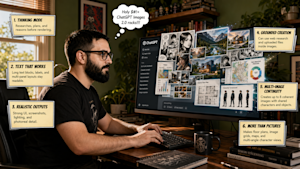
OpenAI ChatGPT Images 2.0: Revolutionary AI Creates Flawless Multilingual Infographics
OpenAI has officially launched ChatGPT Images 2.0, marking a revolutionary leap forward in AI image generation capabilities that promises to transform how we create visual content. The groundbreaking update, announced on April 21, 2026, introduces seamless multilingual text generation within images, along with the ability to create professional-grade infographics, presentation slides, maps, and even manga-style artwork with unprecedented accuracy and quality.
This major release comes just months after OpenAI's December 2025 launch of GPT-Image-1.5, which improved instruction following, colors, and lighting in AI-generated images. The new ChatGPT Images 2.0 represents a quantum leap in functionality, addressing one of the most persistent challenges in AI image generation: creating coherent, readable text within visual content across multiple languages.
Breakthrough Multilingual Text Capabilities Transform AI Image Generation
The most significant advancement in ChatGPT Images 2.0 lies in its ability to generate flawless multilingual text within images, a capability that has long eluded AI image generation systems. Unlike previous models that often produced garbled or illegible text, this new version can seamlessly integrate readable text in multiple languages directly into visual compositions.
This breakthrough addresses a critical gap that has limited the practical applications of AI image generation for global businesses and content creators. The ability to create marketing materials, educational content, and professional documents with accurate text in various languages opens up unprecedented opportunities for international collaboration and communication.
Early demonstrations show the system handling complex typography, maintaining proper character spacing, and respecting cultural formatting conventions across different writing systems. From Latin scripts to Chinese characters, Arabic text, and Japanese hiragana and katakana, ChatGPT Images 2.0 demonstrates remarkable versatility in text rendering that rivals traditional graphic design software.
The implications extend far beyond simple text overlay. The AI understands context, automatically adjusting font sizes, colors, and positioning to create visually harmonious compositions. This level of sophistication suggests that OpenAI has made significant advances in understanding the relationship between textual and visual elements in design.
Professional-Grade Infographics and Presentations at AI Speed
ChatGPT Images 2.0's ability to create comprehensive infographics and presentation slides represents a paradigm shift for content creators, marketers, and business professionals. The system can generate complex data visualizations, complete with charts, graphs, icons, and explanatory text, all from simple natural language prompts.
This capability addresses a significant pain point for many professionals who lack advanced design skills or access to expensive software. The AI can interpret data, understand relationships between different pieces of information, and present them in visually compelling formats that communicate complex concepts effectively.
The presentation slide functionality appears particularly robust, with the AI demonstrating an understanding of visual hierarchy, information flow, and professional design principles. Users can request entire slide decks, and the system will create cohesive presentations with consistent styling, appropriate color schemes, and logical information architecture.
Perhaps most impressively, the system shows remarkable adaptability to different industries and use cases. Whether creating medical infographics with anatomical accuracy, business presentations with corporate aesthetics, or educational materials with engaging visual elements, ChatGPT Images 2.0 appears to understand and adapt to context-specific requirements.
Creative Applications: From Maps to Manga
The creative applications of ChatGPT Images 2.0 extend well beyond traditional business use cases. The system's ability to generate detailed maps demonstrates sophisticated spatial reasoning and geographical knowledge. These aren't simple schematic representations but detailed, accurate cartographic visualizations that could serve professional navigation and planning purposes.
The manga creation capability showcases the AI's understanding of artistic styles, narrative visual conventions, and cultural aesthetics. This feature could revolutionize content creation for entertainment, education, and marketing by making high-quality illustrated content accessible to creators without traditional artistic training.
These diverse capabilities suggest that OpenAI has achieved a significant breakthrough in multimodal AI understanding. The system doesn't just generate images; it demonstrates comprehension of different visual languages, cultural contexts, and artistic conventions. This level of sophistication points to fundamental advances in how AI systems process and synthesize visual information.
The creative applications also highlight the democratizing potential of this technology. Independent creators, small businesses, and educational institutions can now access capabilities that previously required teams of specialized professionals and expensive software licenses.
Industry Impact and Competitive Landscape
The launch of ChatGPT Images 2.0 arrives at a critical moment in the AI industry, as companies race to develop more sophisticated multimodal capabilities. OpenAI's latest advancement significantly raises the bar for competitors, potentially disrupting established markets in graphic design, content creation, and marketing services.
Traditional design software companies may find their market positions challenged as AI-generated content approaches professional quality while offering unprecedented speed and accessibility. The implications extend beyond individual users to entire industries built around visual content creation.
The multilingual capabilities particularly position OpenAI to capture global markets where localized content creation has traditionally required extensive human resources. Companies operating internationally could dramatically reduce costs and time-to-market for marketing materials, training documents, and customer communications.
However, this advancement also raises important questions about the future of creative professions. While the technology democratizes access to high-quality visual content creation, it may also displace certain types of routine design work. The industry will likely see a shift toward more strategic, conceptual, and highly specialized creative roles.
The competitive response from other AI companies will be crucial to watch. Google, Adobe, Microsoft, and other major players will likely accelerate their own multimodal AI development to maintain competitive positioning. This could lead to rapid advancement across the industry, ultimately benefiting end users through improved capabilities and potentially lower costs.
Technical Achievements and Underlying Innovation
The technical achievements underlying ChatGPT Images 2.0 represent significant advances in several areas of AI research. The seamless integration of text and visual elements suggests major improvements in multimodal learning, where AI systems understand relationships between different types of content.
The multilingual text generation capability likely required extensive training on diverse language datasets and sophisticated understanding of typography across different writing systems. This achievement demonstrates OpenAI's continued leadership in large-scale AI training and its ability to tackle complex, multifaceted challenges.
The system's ability to create coherent infographics and presentations indicates advanced reasoning capabilities about information hierarchy, visual communication principles, and audience-appropriate design choices. These aren't simply pattern-matching exercises but demonstrate genuine understanding of how visual elements communicate meaning.
The consistency and quality of outputs across such diverse applications suggest robust underlying architecture that can generalize across different visual domains while maintaining high standards. This level of versatility typically requires sophisticated training methodologies and carefully curated datasets.
Implications for Health and Productivity Optimization
The release of ChatGPT Images 2.0 has significant implications for health and productivity optimization, areas where clear visual communication can dramatically impact outcomes. Healthcare professionals could leverage the AI's infographic capabilities to create patient education materials that are both culturally appropriate and linguistically accessible.
For productivity applications, the ability to rapidly create professional presentations and visual summaries could eliminate major time sinks in knowledge work. Teams could focus on strategic thinking and decision-making rather than spending hours on visual formatting and design iteration.
The multilingual capabilities open new possibilities for global collaboration and knowledge sharing, reducing communication barriers that often impede productivity in international organizations. Visual content that automatically adapts to local languages and cultural contexts could significantly improve information dissemination and comprehension.
In health contexts, the precision of text rendering in multiple languages could be crucial for medical instructions, safety information, and educational materials where accuracy is literally a matter of life and death. The AI's apparent attention to cultural formatting conventions suggests it could create materials that are not just linguistically correct but culturally appropriate.
What's Next: Future Development and Market Evolution
The launch of ChatGPT Images 2.0 likely represents just the beginning of rapid evolution in AI image generation capabilities. OpenAI's pattern of iterative improvement suggests we can expect continued refinements and new features in the coming months.
Key areas to watch include real-time collaboration features, integration with existing design workflows, and potential API expansions that could enable third-party developers to build specialized applications. The company may also explore industry-specific optimizations for healthcare, education, marketing, and other sectors with unique visual communication needs.
The broader market response will shape future development directions. If competitors respond with similar capabilities, we may see rapid commoditization of basic visual content creation, pushing innovation toward more specialized and sophisticated applications.
Regulatory considerations may also influence development, particularly around intellectual property, cultural sensitivity, and potential misuse of highly realistic image generation capabilities. OpenAI will likely need to balance capability advancement with responsible deployment practices.
For more tech news, visit our news section.
As AI continues to revolutionize how we create and consume visual content, staying informed about these developments becomes crucial for anyone looking to optimize their productivity and effectiveness. The intersection of AI-powered content creation with health communication and productivity enhancement represents an exciting frontier where technology directly serves human wellbeing and performance. Join the Moccet waitlist to stay ahead of the curve.