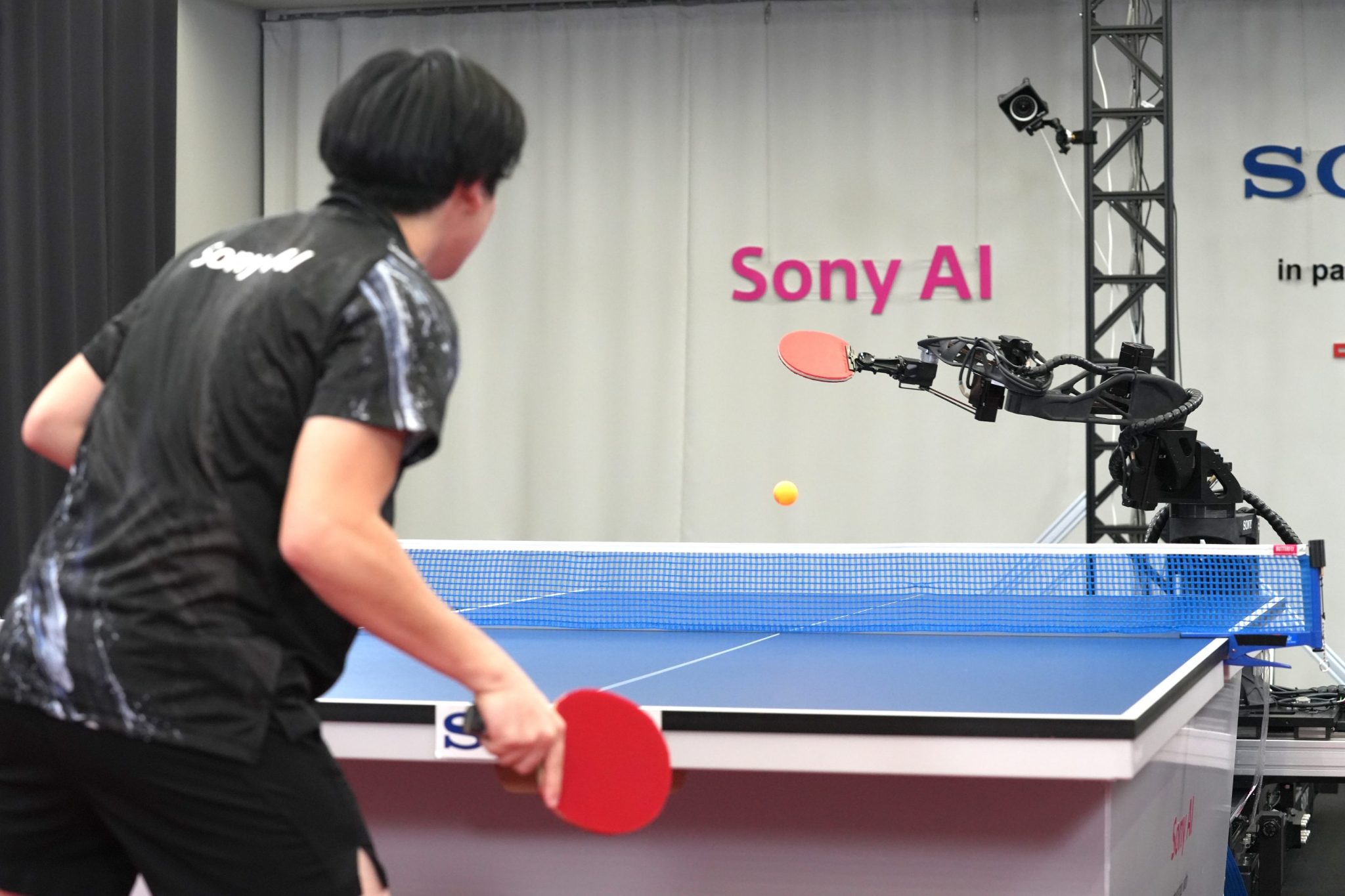
Meet ‘Ace,’ the paddle-wielding robot who just beat humans at ping pong in AI breakthrough
```json { "title": "Sony's Ace Robot Beats Pro Ping-Pong Players in AI Breakthrough", "metaDescription": "Sony's AI robot Ace defeated professional table tennis players in a landmark study published in Nature on April 22, 2026. Here's what it means for AI and robotics.", "content": "<h2>Sony's Ping-Pong Robot 'Ace' Defeats Professional Players in Historic AI Milestone</h2><p>Sony's robotic arm 'Ace' has beaten professional table tennis players in head-to-head competition, marking what the company claims is the first time an autonomous robot has achieved expert-level play in a widely practiced competitive sport in the physical world. The breakthrough was published on April 22, 2026, in the peer-reviewed journal <em>Nature</em>, following months of increasingly competitive matches held at Sony's Tokyo headquarters under official International Table Tennis Federation (ITTF) rules, with umpires from the Japanese Table Tennis Association overseeing the games.</p><p>The robot — a custom-built, eight-jointed robotic arm equipped with nine active pixel sensor cameras and three event-based vision systems — did not arrive at this result overnight. Its journey from losing to professionals to defeating them unfolded over roughly a year of iterative improvement, making its story as much about the pace of AI development as it is about table tennis.</p><h2>From Losing to Professionals to Beating Them: Ace's Competitive Record</h2><p>The public timeline of Ace's competitive record tells a rapid and striking story of improvement. In April 2025, Ace was evaluated against five elite players — each with at least 10 years of experience and approximately 20 hours of weekly training — and two professional players, Minami Ando and Kakeru Sone, both active in Japan's professional table tennis league. Ace won three of the five matches against elite players but lost both matches against the professionals.</p><p>By December 2025, performance had improved significantly. Competing against four high-skill players, Ace defeated all but one of them, and won one of two matches against professional opponents. In that December round, professional player Mayuka Taira was among those who lost to the robot.</p><p>The most recent results, from March 2026, represent the clearest demonstration of competitive capability to date. Ace won three matches against professional players, including Miyuu Kihara, who is currently ranked in the top 25 of the World Table Tennis rankings for women's singles.</p><p>Across the April 2025 matches, Ace achieved a serve return rate of over 75% against elite players and scored 16 unchallenged points — or 'aces' — after serving against multiple elite competitors. These numbers, drawn from the <em>Nature</em> study, help contextualize how the robot's performance translates into actual match dynamics rather than isolated technical metrics.</p><h2>How Ace Works: Vision, Speed, and Reinforcement Learning</h2><p>Ace's technical architecture is central to understanding both its capabilities and the debate around how to evaluate its achievement. The robot integrates nine synchronized frame-based cameras with three event-based vision systems, all produced by Sony Semiconductor Solutions. According to Sony AI's blog, the system tracks a table tennis ball at 200 Hz with millimeter accuracy and approximately 10 milliseconds of latency, while measuring ball spin at up to 700 Hz — a level of perceptual speed that far exceeds human reaction time.</p><p>The robot's eight joints are allocated precisely: three control the racket's position, two manage its orientation, and three govern shot speed and strength. This mechanical specificity was designed to give the arm the range and responsiveness needed for competitive play.</p><p>Rather than being hand-coded with table tennis rules or strategies, Ace's AI was trained using deep reinforcement learning — a trial-and-error approach conducted in simulated virtual environments before being transferred to the physical robot. The system also tracks the ball's logo to measure spin, an approach that allows it to respond to a variable that human players typically rely on feel and anticipation to read.</p><p>Sony built an Olympic-sized table tennis court at its Tokyo headquarters specifically to conduct the experiments, and all matches were judged by official umpires under ITTF rules — a methodological detail that gives the competitive results a level of formal validity beyond a controlled laboratory setting.</p><p>This approach builds on Sony AI's earlier work with Gran Turismo Sophy, an AI agent designed to outrace human players in the video game Gran Turismo. The leap from a digital racing simulation to a physical, real-time sport against professional human opponents represents a substantially different class of challenge.</p><h2>Why This Matters: Physical AI Enters a New Phase</h2><p>The significance of Ace extends beyond what happens across a table tennis net. Table tennis is a sport that demands split-second decisions, precise physical control, and the ability to respond to an unpredictable human opponent in real time — conditions that have historically been far harder for AI systems to navigate than the controlled, turn-based, or purely digital environments where AI has previously excelled.</p><p>Robotics has had ping-pong-playing machines since 1983, when John Billingsley — now a retired mechatronics professor at the University of Southern Queensland in Australia — published the first robot table tennis paper, titled 'Robot Ping-Pong.' But according to reporting from KSL.com and multiple Associated Press-sourced outlets, none of those systems had been able to rival highly skilled human competitors until Ace.</p><p>Sony AI president Michael Spranger has described the past year as a kind of turning point for the field broadly. The implications, as outlined by Sony's research team, are not limited to sport. The same techniques that allow Ace to track a fast-moving ball and respond with precision in real time have potential applications in manufacturing robotics, service robotics, and other domains where machines must interact safely and effectively with humans at speed.</p><h2>Expert Reactions: Landmark Achievement, With Caveats</h2><p>The research has drawn substantive commentary from figures both inside and outside Sony AI.</p><p>Peter Dürr, director of Sony AI Zurich and lead author of the <em>Nature</em> study, framed the core challenge clearly: <em>"There's no way to program a robot by hand to play table tennis. You have to learn how to play from experience."</em> He also situated the achievement within the broader landscape of AI research: <em>"Unlike computer games, where prior AI systems surpass human experts, physical and real-time sports such as table tennis remain a major open challenge due to their requirements for fast, precise and adversarial interactions near obstacles and at the edge of human reaction time."</em></p><p>On the question of why this research matters beyond sport, Dürr was direct: <em>"Sony AI conducted this research to study how AI could operate safely and effectively in the physical world, where perception, control, and agility must come together in real time."</em> He also pointed to potential downstream applications: <em>"The success of Ace, with its perception system and learning-based control algorithm, suggests that similar techniques could be applied to other areas requiring fast, real-time control and human interaction — such as manufacturing and service robotics, as well as applications across sports, entertainment and safety-critical physical domains."</em></p><p>Michael Spranger, president of Sony AI, emphasized the speed problem at the heart of modern robotics: <em>"Speed is really one of the fundamental issues in robotics today, especially in scenarios or environments that are not fixed."</em> He also described the current moment in broader terms, saying the past year has marked a <em>"kind of ChatGPT moment for robotics."</em></p><p>Peter Stone, chief scientist at Sony AI, offered one of the most expansive assessments: <em>"This breakthrough is much bigger than table tennis. It represents a landmark moment in AI research, showing, for the first time, that an AI system can perceive, reason, and act effectively in complex, rapidly changing real-world environments that demand precision and speed."</em></p><p>Not all observers are without reservations. John Billingsley, who pioneered the field of robot table tennis research more than four decades ago, acknowledged the achievement while raising a methodological point: <em>"I would not want to belittle the achievement, but they have gone at the task mob-handed, and used sledgehammer techniques."</em> His comment reflects a broader debate in robotics about whether systems that rely on extensive sensor arrays and computational resources represent the same kind of generalized intelligence that human athletes deploy.</p><p>From the human side of the net, professional player Mayuka Taira, who lost a match to Ace in December 2025, offered a competitor's perspective on what makes the robot difficult to face: <em>"It is very hard to predict, and it shows no emotion."</em> She elaborated: <em>"Because you can't read its reactions, it's impossible to sense what kind of shots it dislikes or struggles with, and that makes it even more difficult to play against."</em></p><p>Olympian Kinjiro Nakamura, who competed in the 1992 Barcelona Olympics and was present to observe Ace, noted that the robot performed a shot he said no human could have made — a remark that was included in the <em>Nature</em> paper itself.</p><h2>What Comes Next</h2><p>The <em>Nature</em> publication formalizes a body of research that has been accumulating through real-world matches since at least April 2025. With results now peer-reviewed and publicly available, the question shifts from whether Ace can compete at a professional level to what the underlying technology can be adapted to do in other contexts.</p><p>Sony AI's own stated ambitions point toward manufacturing and service robotics as natural extensions of the work — domains where fast, precise, real-time interaction with humans and unpredictable physical environments is already a pressing need. Whether the specific techniques developed for Ace translate cleanly to those settings remains to be demonstrated, but the research provides a documented, formally validated foundation to build from.</p><p>The trajectory of Ace's competitive results — from losing to professionals in April 2025 to defeating top-25 ranked professionals in March 2026 — also raises questions about the pace at which AI systems in physical domains are improving, and what benchmarks the field will set next.</p><p>For now, the record stands: a robot trained through reinforcement learning, perceiving the world through nine cameras at speeds beyond human reaction time, has won matches against professional table tennis players under official competitive rules. Whether that represents a ceiling or a threshold is the question the broader robotics and AI research community will be working to answer.</p><p>For more tech news, visit our <a href=\"/news\">news section</a>.</p><h2>What This Means for Human Performance and Productivity</h2><p>The same reinforcement learning and real-time sensory processing techniques powering Ace are increasingly relevant to human performance research — from adaptive training systems in sports science to AI-assisted tools that help people work faster and more accurately under time pressure. As physical AI matures, its overlap with health optimization and productivity technology will only deepen. Moccet tracks these developments so you don't have to. <a href=\"/#waitlist\">Join the Moccet waitlist to stay ahead of the curve.</a></p>", "excerpt": "Sony's AI robot 'Ace' has beaten professional table tennis players in competition, with results published in the journal Nature on April 22, 2026. The robotic arm uses reinforcement learning and nine cameras to track and return shots at speeds beyond human reaction time. Sony calls it the first robot to achieve expert-level play in a widely practiced competitive sport in the physical world.", "keywords": ["Sony Ace robot", "AI ping pong robot", "table tennis robot", "reinforcement learning robotics", "physical AI breakthrough"], "slug": "sony-ace-robot-beats-pro-ping-pong-players-ai-breakthrough" } ```