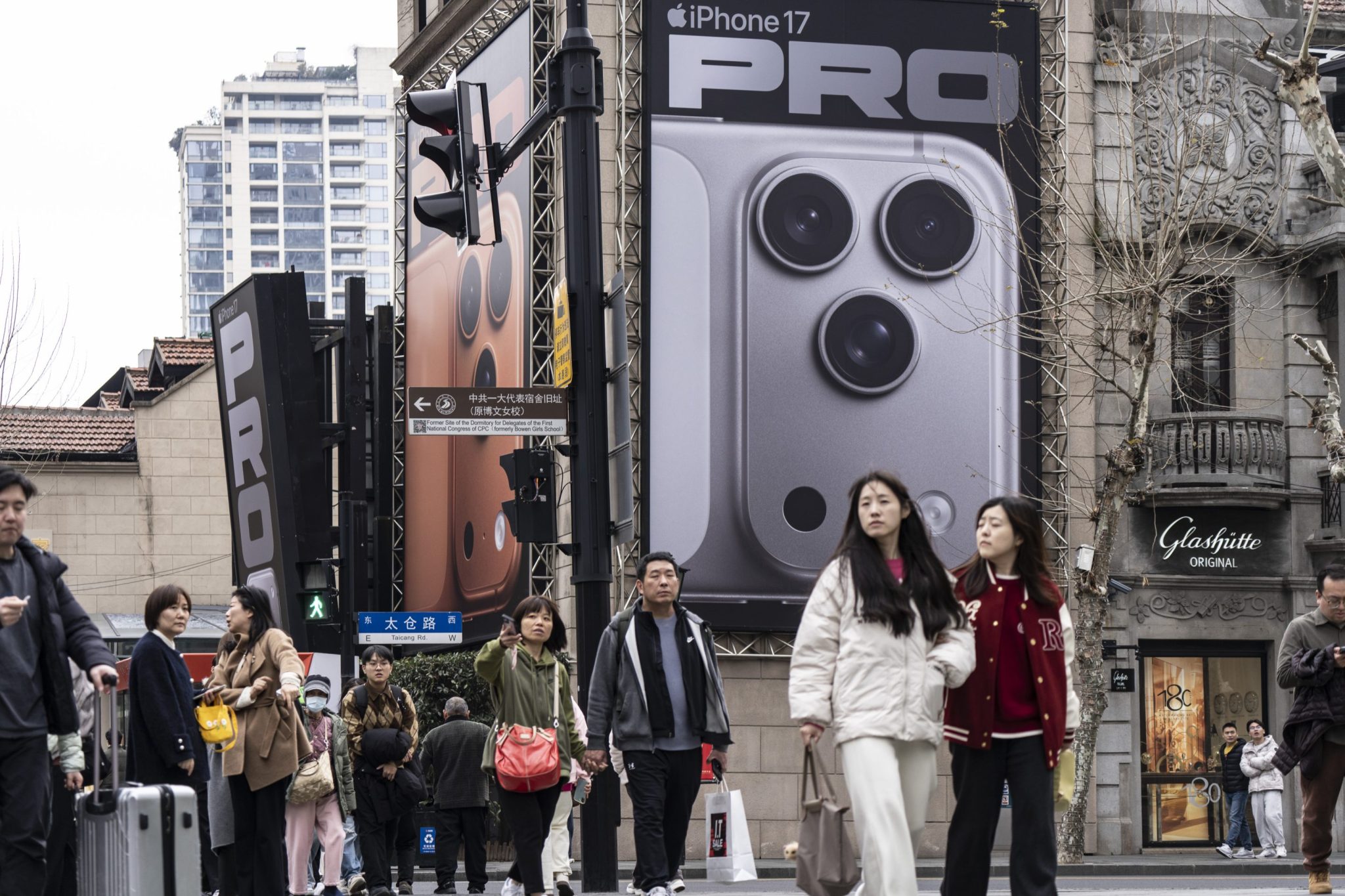
John Ternus, Apple’s new CEO, inherits a rebounding China business—and some messy headaches
```json { "title": "John Ternus Becomes Apple CEO Amid China Rebound", "metaDescription": "John Ternus succeeds Tim Cook as Apple CEO on September 1, 2026, inheriting a rebounding China business and complex geopolitical headaches.", "content": "<h2>John Ternus Named Apple CEO as Tim Cook Moves to Executive Chairman</h2><p>Apple announced on April 20, 2026 that John Ternus, currently Senior Vice President of Hardware Engineering, will become the company's next CEO effective September 1, 2026. Tim Cook, who has led Apple for 15 years, will transition to executive chairman of the board of directors. The move was approved unanimously by Apple's board and follows what the company describes as a long-term succession planning process.</p><p>Ternus inherits both a company at the height of its market power — Apple's value surpassed $4 trillion under Cook — and a set of interlocking strategic challenges, none more complex than the company's relationship with China. A dramatic rebound in Apple's Greater China revenue has given the incoming CEO a strong opening position, but regulatory friction over artificial intelligence, ongoing US-China trade tensions, and a manufacturing footprint that remains deeply tied to Chinese factories mean the road ahead is anything but straightforward.</p><h2>Who Is John Ternus? From Penn Engineer to Apple's Top Job</h2><p>Ternus earned a bachelor's degree in mechanical engineering from the University of Pennsylvania in 1997 and joined Apple in 2001 as a member of the product design team. He rose steadily through the organization's hardware ranks, and in 2021 was promoted to Senior Vice President of Hardware Engineering — at the time making him the youngest member of Apple's executive team. In that role, he oversaw the engineering teams responsible for the iPhone, iPad, Mac, Apple Watch, AirPods, and the Vision Pro headset.</p><p>Bloomberg's Mark Gurman had reported, based on sources inside the company, that industry observers and Apple insiders had long viewed Ternus as the most likely candidate to succeed Cook. His appointment signals a tilt toward technically-oriented leadership at a moment when Apple is working to close a perceived gap in artificial intelligence relative to its major competitors.</p><p>In a statement published on Apple's newsroom, Ternus said: <em>"I am profoundly grateful for this opportunity to carry Apple's mission forward."</em> He added: <em>"Having spent almost my entire career at Apple, I have been lucky to have worked under Steve Jobs and to have had Tim Cook as my mentor."</em></p><p>Cook offered a pointed endorsement of his successor: <em>"John Ternus has the mind of an engineer, the soul of an innovator, and the heart to lead with integrity and with honor."</em></p><p>Apple Board Chairman Arthur Levinson echoed that confidence: <em>"We believe John is the best possible leader to succeed Tim and as he transitions to CEO we know his love of Apple, his leadership, deep technical knowledge, and relentless focus on creating great products will help lead Apple to an extraordinary future."</em></p><h2>China's Rebound: Apple's Best Quarter in Years — and Its Biggest Unresolved Problem</h2><p>The China story Ternus inherits has two very different chapters written in quick succession. In fiscal Q1 2025, Apple's Greater China revenue fell 11.1% to $18.51 billion — the steepest regional decline since a nearly 13% drop in Q1 2024. At the time, Cook pointed directly to the absence of Apple Intelligence in China as a contributing factor, telling CNBC: <em>"During the December quarter, we saw that in markets where we had rolled out Apple Intelligence, that the year-over-year performance on the iPhone 16 family was stronger than those markets where we had not rolled out Apple Intelligence."</em></p><p>The turnaround in fiscal Q1 2026 was striking. Apple reported $25.5 billion in Greater China segment sales for the quarter ended December 27, 2025 — a 38% year-over-year surge that far exceeded Wall Street's average forecast of $21.8 billion. iPhone shipments in China rose 20% year over year in Q1 2026, according to Counterpoint Research data cited by Motley Fool, even as overall Chinese smartphone shipments declined 4% during the same period. In the first nine weeks of 2026, iPhone sales in China surged 23% while the broader market fell 4%, according to Counterpoint Research data cited by CNBC.</p><p>The recovery was driven by a combination of factors: strong demand for the iPhone 17, government-backed trade-in subsidies that covered the base iPhone 17 model, and online retail promotions. Apple also led China's smartphone market in Q4 2025 with a 22% share and 28% year-over-year sales growth, according to Counterpoint Research.</p><p>But the rebound has a conspicuous asterisk: Apple Intelligence, Apple's flagship AI feature suite, has still not officially launched in China as of late April 2026. On March 30, 2026, the feature briefly appeared on iPhones in China before being pulled offline within hours. Bloomberg's Mark Gurman confirmed the launch was accidental, writing: <em>"Apple Intelligence launched in China in error. It's been ready to go for months, but Apple doesn't yet have regulatory approval."</em></p><p>Apple has been working with both Alibaba and Baidu as local AI partners. Alibaba has been developing an on-device system to filter and censor AI output to meet Chinese regulatory requirements, while Baidu is powering AI search features and Siri upgrades. The negotiations have involved significant technical and regulatory complexity, and no launch date has been confirmed. The unresolved status of Apple Intelligence in its second-largest market represents a material business risk — the same AI gap that Cook identified as a drag on performance in early 2025 has not yet been closed.</p><h2>Tariffs, Manufacturing, and the Washington-Beijing Squeeze</h2><p>Beyond the AI regulatory question, Ternus steps into a geopolitical environment that has grown more fraught since Cook first navigated its early contours. US tariffs on Chinese imports are expected to cost Apple an additional $900 million in the June 2025 quarter alone, according to figures Cook disclosed on the company's earnings call. That single-quarter cost has accelerated Apple's push to diversify its manufacturing base.</p><p>Apple has shifted assembly of iPads, Macs, Apple Watches, and AirPods to Vietnam and plans to move most iPhone assembly destined for the US market to India. However, the scale of the China dependency remains enormous: approximately 80% of the roughly 60 million iPhones sold annually in the US are currently assembled in China. That footprint cannot be unwound quickly or cheaply, and any further escalation in trade policy between Washington and Beijing would fall directly on Ternus's desk.</p><p>Cook's move to executive chairman carries a specific relevance here. According to CNBC, Cook will assist with certain aspects of the company in his new role, including engaging with policymakers around the world — a function that reflects just how central government relations have become to Apple's operational reality. Ternus, as an engineer-turned-CEO without Cook's decades of diplomatic relationship-building in both Washington and Beijing, will need to lean on that institutional continuity.</p><p>CNBC also noted that Apple faces additional structural headwinds beyond tariffs and geopolitics: an increasingly complex global supply chain, and a memory crunch tied to soaring demand for AI chips. The company revamped its AI leadership in December 2025, replacing its former AI chief with a Google veteran, and has said it will launch an updated version of Siri based on a Google Gemini AI model — a significant strategic signal about the state of Apple's internal AI capabilities.</p><h2>Context: What This Leadership Transition Means</h2><p>Cook's 15-year tenure was defined by operational mastery, global supply chain orchestration, and the kind of relationship capital with governments that took years to build. Under his watch, Apple shares appreciated more than 1,700% and the company's market value grew to more than $4 trillion. The transition to Ternus marks a generational shift: from a leader whose core skill set was logistics and diplomacy to one whose career was built on hardware engineering and product development.</p><p>That shift arrives at a moment when Apple's most pressing competitive battles — in AI, in China, and in the regulatory arena — are simultaneously technical, political, and commercial. Apple Intelligence's delayed China rollout is not purely a regulatory problem; it is also an engineering and partnership challenge of the kind that falls squarely within the hardware and software integration work Ternus has led for years. His track record on the iPhone, Apple Silicon, and Vision Pro suggests he understands how to ship complex technology at scale. Whether he can translate that competency into the boardrooms of Beijing and Washington remains an open question.</p><p>For users and enterprises who depend on Apple's ecosystem — for communication, productivity, and increasingly for AI-assisted workflows — the leadership change is a signal worth watching. The pace at which Apple can bring Apple Intelligence to China, manage its supply chain under tariff pressure, and deliver meaningful AI upgrades to Siri will shape the company's competitive position for years to come.</p><p>For more tech news, visit our <a href=\"/news\">news section</a>.</p><h2>What Comes Next</h2><p>Ternus officially takes the CEO role on September 1, 2026. Between now and then, Apple is expected to navigate its next earnings cycle, continue supply chain restructuring toward India and Vietnam, and — most critically — push toward a regulatory resolution that would allow Apple Intelligence to launch in China. The company's AI partnership discussions with Alibaba and Baidu remain ongoing, and no timeline has been publicly confirmed for a compliant Chinese rollout.</p><p>Cook's continued presence as executive chairman, particularly in his engagement with global policymakers, provides some continuity during the handover period. But the strategic decisions that will define the next chapter of Apple's China relationship — and its AI ambitions globally — will increasingly fall to Ternus.</p><p>Apple's next major product cycle, the iPhone 18, is also expected to arrive during Ternus's first months as CEO, giving the incoming leader an early high-profile test. How Apple Intelligence features are positioned globally, and whether China can finally be included, will be among the most closely watched storylines of his opening act.</p><hr><p><strong>Apple, productivity, and AI are converging fast.</strong> For professionals and health-conscious individuals who rely on Apple devices for focus, communication, and personal optimization, the decisions made in Cupertino and Beijing over the next 12 months will directly shape the tools available to them. Staying informed about how AI integrates into the platforms you use every day isn't just tech news — it's a productivity advantage. <a href=\"/#waitlist\">Join the Moccet waitlist to stay ahead of the curve.</a></p>", "excerpt": "Apple announced on April 20, 2026 that John Ternus will succeed Tim Cook as CEO on September 1, 2026, inheriting a dramatically rebounding China business and a set of unresolved challenges including AI regulatory hurdles, US tariffs, and deep manufacturing dependencies. Tim Cook moves to executive chairman, where he will continue engaging with global policymakers. Ternus becomes CEO at a pivotal moment for Apple's artificial intelligence strategy and its position between Washington and Beijing.", "keywords": ["John Ternus Apple CEO", "Apple China revenue", "Tim Cook executive chairman", "Apple Intelligence China", "Apple tariffs supply chain"], "slug": "john-ternus-apple-ceo-china-rebound-challenges" } ```