Jeff Bezos: AI Will Create a Labor Shortage, Not a Jobs Crisis
Bezos Makes His Case at VivaTech as Prometheus Hits a $41B Valuation
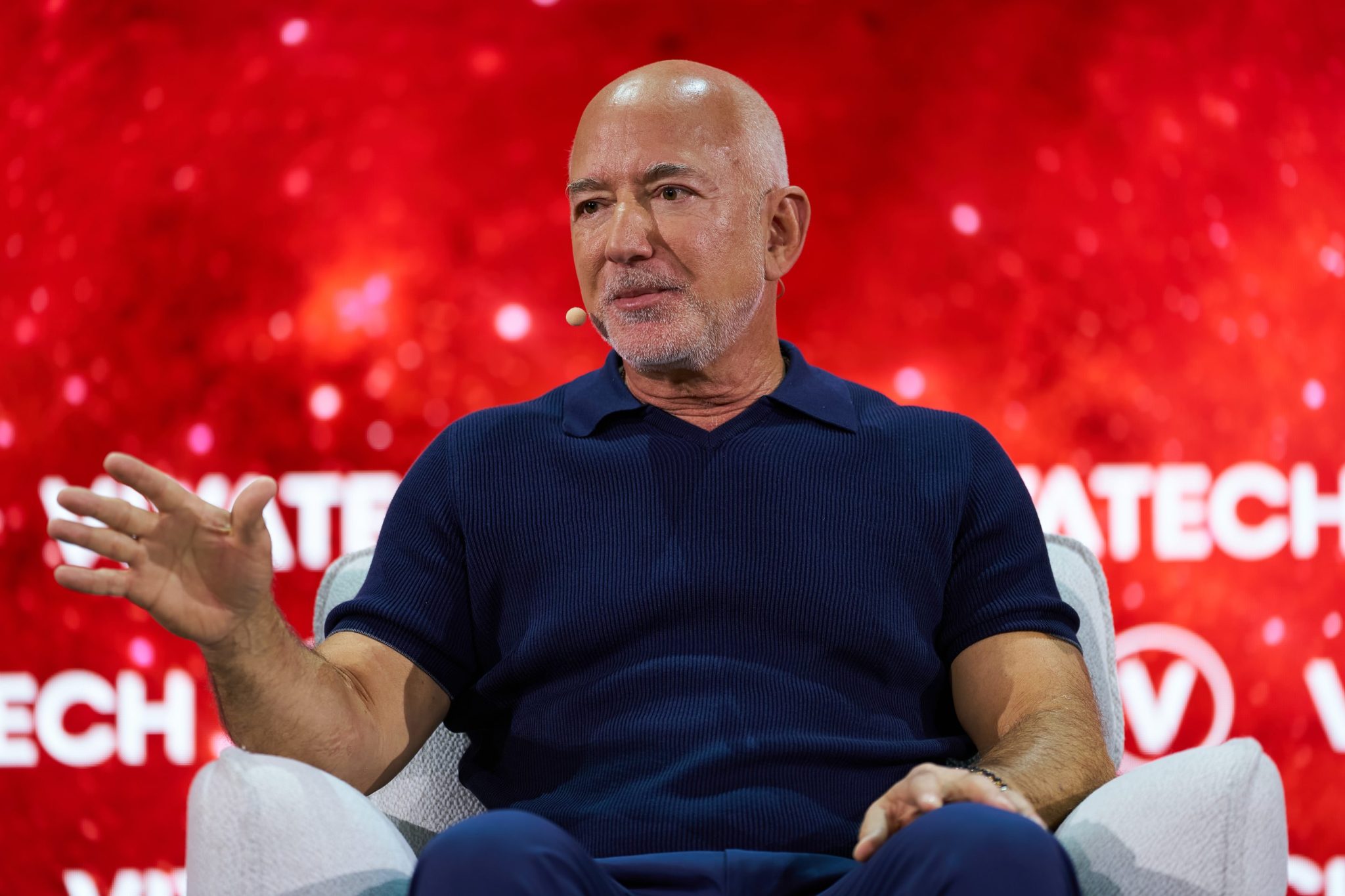
Jeff Bezos stepped onto the stage at the VivaTech technology conference in Paris on June 17, 2026, and made a bet that cuts against prevailing anxiety about artificial intelligence: AI, he argued, will not eliminate jobs en masse. It will create a shortage of workers to fill them.
The appearance doubled as a public debut for Prometheus, the industrial AI startup Bezos co-founded and co-leads with scientist Vik Bajaj. The company had formally announced a $12 billion Series B funding round just six days earlier, on June 11, 2026, pushing its valuation to approximately $41 billion. With total funding now exceeding $18 billion, Prometheus has become one of the most heavily capitalized AI startups in the world — despite having launched only in November 2025 and employing roughly 150 people across offices in San Francisco, London, and Zurich.
The timing of Bezos's optimistic remarks was notable. According to data from executive outplacement firm Challenger, Gray & Christmas, AI accounted for more than a quarter of all U.S. job cuts in April 2026 alone, with 21,490 positions eliminated due to the technology. The same firm tracked over 49,000 AI-related layoffs in the first months of 2026, making AI the third-largest driver of planned job cuts in that period. Meanwhile, a Reuters/Ipsos poll from June 2026 found that half of Americans fear AI could put them or someone in their household out of work.
Bezos was direct in pushing back against that fear.
"I know there's a lot of concern that many people have, including many smart people, that AI is going to make humans redundant and so on. I totally disagree with this point of view. And I think, in fact, AI is going to create a labor shortage," he said at VivaTech.
What Prometheus Actually Builds — And Why It Needs $18 Billion to Do It
Prometheus is not a general-purpose AI company. According to TechCrunch, the startup is building what it calls an "artificial general engineer" — software designed to automate the design and manufacturing of complex physical systems, spanning categories as different as jet engines and pharmaceutical drug compounds. The goal is to dramatically compress the cycle time between a concept and a finished, manufacturable product.
Bezos has framed this as solving one of the most stubborn bottlenecks in industrial civilization. "The cycle from dream, to manufacturing at rate, to having it out in the world can be very long," he said in remarks reported by Axios and Benzinga. "What Prometheus seeks to do is to offer a set of tools that dramatically accelerates that invention loop," he told The New York Times, as cited by Entrepreneur.
Bajaj, who co-founded Google Life Sciences — later rebranded as Verily under Alphabet — and serves as an adjunct professor at Stanford University's School of Medicine, described the core problem Prometheus is trying to solve in similarly broad terms. "The pace of our physical creation right now is nowhere near the pace of human imagination," he said, according to Yahoo Finance and Benzinga. He has also pointed to a recent shift in AI capabilities as enabling what Prometheus is attempting: "What has changed in the last few years is the ability to formulate even something as complicated as that, from design to manufacturing, as an end-to-end AI problem."
Bezos was equally concrete about the product itself: "We're building tools that will make it much easier for engineers to design physical objects," he told CNBC.
The company's capitalization reflects the scale of the ambition. Bezos acknowledged as much without qualification: "This is a capital-intensive startup, there's no question about that." Investors in the Series B include JPMorgan, BlackRock, Goldman Sachs, DST Global, and Arch Venture Partners, alongside Bezos himself. The initial $6.2 billion Series A, launched in November 2025, had Bezos as its largest backer.
According to Axios, there are also reports of a related effort to raise $100 billion for an affiliated holding company that would acquire legacy industrial companies and use their data to train Prometheus's systems — though both Bezos and Bajaj declined to discuss that effort publicly.
Prometheus operates independently of Amazon and Blue Origin. When asked why the company was not built inside one of those existing organizations, Bezos was straightforward: "It deserves a dedicated team that is obsessed with this one thing."

The Labor Debate: Bezos's Optimism Versus the Data on the Ground
The central tension around Bezos's VivaTech remarks is that they arrive at a moment when the near-term data on AI and employment trends in the opposite direction from his long-term thesis.
Amazon itself — where Bezos now serves as executive chairman, having stepped down as CEO in 2021 — has trimmed approximately 30,000 corporate roles since late 2025, a reduction partly attributed to AI efficiency gains, according to reporting by American Bazaar Online and Reuters. The company still employs more than 1.5 million people worldwide, according to TechCrunch, but the corporate headcount reduction is consistent with a broader pattern documented by Challenger, Gray & Christmas across the U.S. economy.
Bezos's position — that AI will ultimately generate enough economic activity to produce a labor shortage rather than mass unemployment — is a version of the historical argument that past waves of automation, from mechanized looms to industrial robots, ultimately created more jobs than they displaced. A 2024 poll cited by MSN found that nearly two-thirds of U.S. adults believed AI would reduce jobs over the next two decades. Notably, only 39% of AI experts shared that view in the same poll — suggesting the disagreement is not simply between technologists and the general public, but is genuinely contested even among specialists.
What Bezos is specifically arguing, and what Prometheus is designed to demonstrate, is that the productivity gains enabled by AI will expand the total addressable universe of problems engineers can work on — not replace the engineers themselves. The "artificial general engineer" concept is premised on the idea that compressing design cycles will allow humans to pursue more ambitious physical projects, not fewer. Whether that holds at scale, and over what timeline, remains an open question that the data available in mid-2026 does not yet answer.
A $41 Billion Startup With 150 Employees: What Comes Next for Prometheus
Prometheus is, by conventional startup metrics, a striking anomaly. A $41 billion valuation attached to a company with approximately 150 employees and no publicly disclosed commercial product represents a bet on future potential of an unusual magnitude — even by the standards of the current AI investment cycle.
The first public interview with both Bezos and Bajaj speaking together about the company was conducted by CNBC's David Faber at Prometheus's San Francisco headquarters on June 11, 2026, the same day the Series B was announced. VivaTech on June 17 marked Bezos's first solo public appearance in that capacity.
The company has not disclosed a product launch timeline, commercial customers, or revenue figures. What is known is that it is hiring — 150 employees across three cities is a lean foundation for a company with ambitions that span jet engines, pharmaceuticals, and industrial manufacturing — and that its investor base now includes some of the largest financial institutions in the world. The involvement of JPMorgan, BlackRock, and Goldman Sachs in a Series B is itself a signal about how institutional capital is positioning itself relative to industrial AI.
The reported $100 billion affiliated holding company, if it materializes, would represent a different kind of play: not just building AI tools for engineers, but acquiring the legacy industrial companies whose operational data would be necessary to train those tools. Bezos and Bajaj have declined to comment on that front, and it remains unconfirmed.
For now, what Prometheus has made public is a thesis, a team, a location, and an exceptionally large war chest. Whether the "artificial general engineer" it is building can deliver on the promise that AI accelerates physical invention rather than simply reducing the headcount required to pursue it will likely take years to assess — and may not be separable from the broader economic question Bezos raised in Paris.
For more tech news, visit our news section.