India and Japan Make Economic Security a Shared Mission
India and Japan Declare Economic Security a Shared Strategic Interest
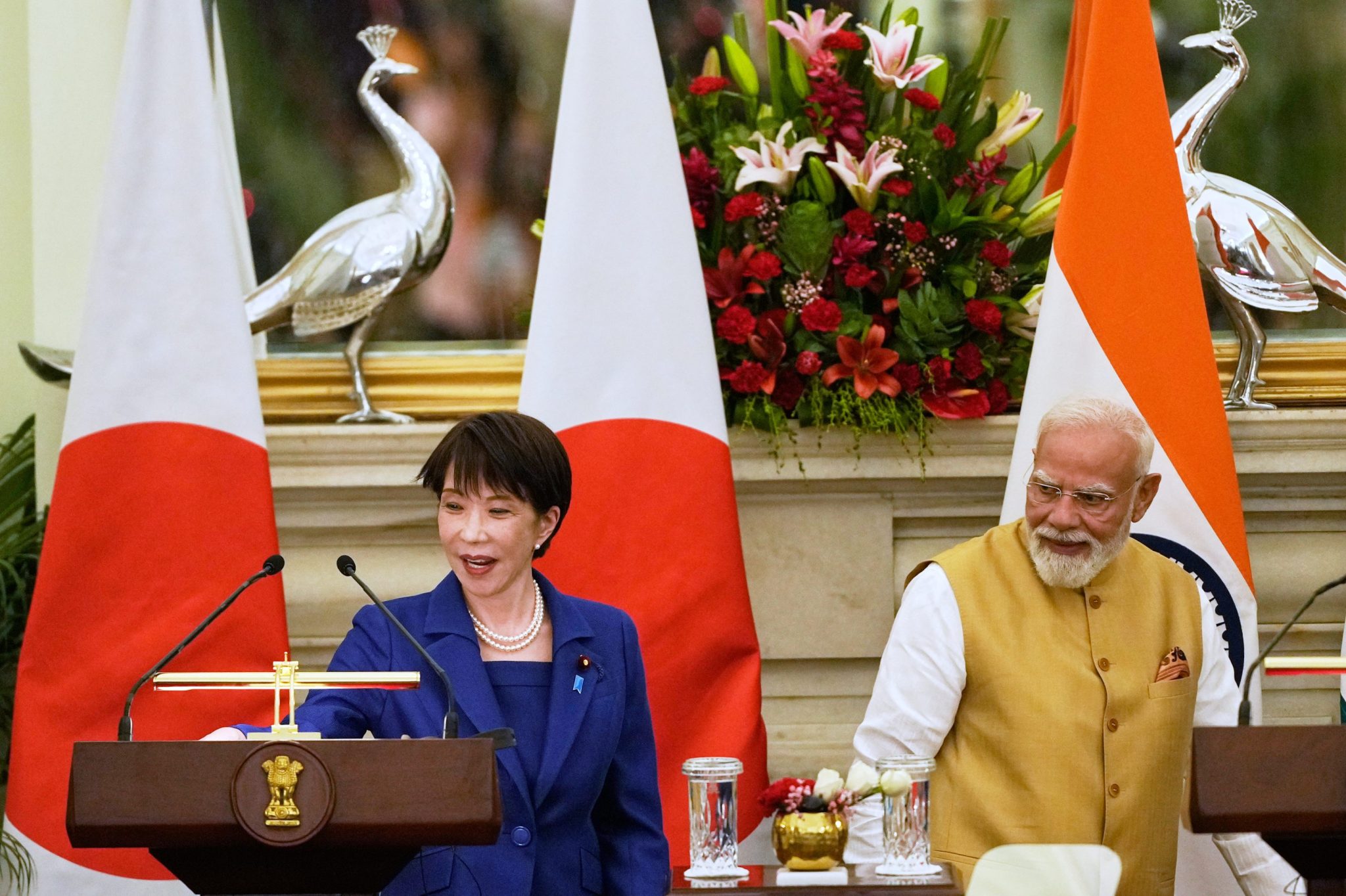
India and Japan formalized one of their most ambitious bilateral agendas to date on July 2, 2026, when Prime Ministers Narendra Modi and Sanae Takaichi concluded the 16th India-Japan Annual Summit in New Delhi. The two leaders signed three landmark documents covering economic security, energy resilience, and artificial intelligence cooperation, announced Japan's pledge to more than double its investment in India to over $61 billion over the next decade, and sealed the two countries' first-ever joint defence co-development project. Against a backdrop of Chinese economic pressure, disrupted energy corridors, and a less engaged United States, both sides signaled that economic security is no longer a peripheral concern — it is now the organizing principle of their partnership.
"India and Japan view economic security as a shared security interest," Prime Minister Modi said at the summit.
A $61 Billion Investment Pledge and 120 Private-Sector Agreements
The financial commitments announced at the summit were substantial. Japan pledged to more than double its investment in India to more than $61 billion over the next decade — a target first announced during Modi's visit to Tokyo in 2025 and reaffirmed in New Delhi. Japanese investment in India already totaled $3.2 billion between April and December 2025, according to Indian government data, and two-way trade reached $27.5 billion in India's 2025–26 fiscal year.
Running alongside the official summit, the Japan-India Economic Forum drew more than 150 Japanese companies, with private-sector participants committing approximately $12.5 billion through around 120 cooperation agreements. India's longer-term ambition is to attract 10 trillion yen in Japanese investment over the next decade and to double the number of Japanese companies operating in the country. A recent deal in which a Japanese firm acquired a 20% stake in Yes Bank for $1.6 billion illustrates the deepening financial integration already underway.
"By uniting government and private sectors, we aim to broaden the scope of Japan-India cooperation and realise a strong economy," Prime Minister Takaichi said at the forum.

AI, Semiconductors, and the UNICORN Defence Project
Technology cooperation sat at the heart of the summit's agenda. Both governments agreed to strengthen collaboration across artificial intelligence, shipbuilding, biogas, semiconductors, and critical technologies. The three landmark documents adopted at the summit — on economic security, energy resilience, and AI — give institutional form to a priority list the two sides first codified at their inaugural Economic Security Dialogue in Tokyo in November 2024, where they identified five sectors for immediate focus: semiconductors, critical minerals, pharmaceuticals, clean energy, and ICT.
On AI specifically, Modi pointed to the complementary strengths each country brings to the table. "The convergence of Japan's precision technology and India's software capabilities will give a new momentum and strength to global AI development," he said.
The summit's most consequential defence announcement was the signing of India and Japan's first joint defence co-development project: the UNICORN naval stealth antenna system. UNICORN is a stealth antenna technology originally developed for Japan's Maritime Self-Defense Force and currently deployed on Japan's Mogami-class frigates. The project builds on a Memorandum of Implementation signed in Tokyo in November 2024. India's Bharat Electronics Limited (BEL) is expected to partner with Japanese agencies in integrating and manufacturing the UNICORN system for the Indian Navy.
"Expansion of maritime security cooperation is especially important for regional peace and stability," Takaichi said.
The China Factor: Export Controls and Strategic Timing
The summit did not take place in a vacuum. Just days before Takaichi departed for New Delhi, China imposed fresh export controls on 40 entities in Japan, including defence contractors and research institutions. The measures were part of a broader set of retaliatory actions — including restrictions on dual-use exports and curbs on seafood imports from Japan — that followed Takaichi's parliamentary remarks that China's military action against Taiwan could pose an existential threat to Japan.
The timing underscored the strategic logic animating the India-Japan partnership. Both countries have faced arbitrary tariffs from the Trump administration, economic disruption from the war in Iran, and the weakening of energy Sea Lines of Communication, according to analysis from the Observer Research Foundation. With the United States having stepped back from active Quad summit leadership, India, Japan, and Australia have accelerated bilateral and trilateral engagement on supply chains, defence industry, and critical technologies.
A Quad Foreign Ministers' Meeting held May 25–27, 2026, confirmed priority areas including economic prosperity and security and critical and emerging technologies, but the momentum for concrete project-level cooperation has increasingly shifted to the non-U.S. members of the grouping. Takaichi visited Australia in May 2026, Australian Defence Minister Richard Marles visited India in May 2026, and Modi is expected to visit Australia in July 2026 — a sequence that reflects a deliberate effort to thicken the trilateral architecture independent of Washington.
"Amid a turbulent international landscape, building such a mutually complementary cooperative relationship has become increasingly important," Takaichi said in New Delhi.
A Partnership Two Decades in the Making
The India-Japan Annual Summit mechanism was established in 2006, and the relationship was elevated to a Special Strategic and Global Partnership in 2014. The July 2, 2026, summit is the 16th edition of that annual mechanism and Takaichi's first official state visit to India as prime minister. The framework now encompasses defence co-development, semiconductor supply chains, clean energy, AI governance, and maritime security — a scope that would have been difficult to imagine when the mechanism was founded.
"Japan and India will leverage each other's strengths to grow strong and prosperous together," Takaichi said.
The UNICORN project is particularly significant as a proof of concept. Previous India-Japan defence cooperation had been limited largely to equipment transfers and exercises. A co-development project involving BEL — one of India's flagship defence public sector undertakings — signals a qualitative shift toward shared industrial capacity, not just shared equipment.
What Comes Next
Several near-term milestones will test whether the commitments made on July 2 translate into durable outcomes. The joint roadmap for economic security, agreed at the summit, will need to be operationalized across the five priority sectors identified at the November 2024 Economic Security Dialogue. The UNICORN co-development project will advance through BEL's integration work, with the Indian Navy's requirements shaping the localization scope. The $61 billion investment target will be tracked against current flows — Japanese investment of $3.2 billion in the first nine months of India's 2025–26 fiscal year suggests the pace will need to accelerate significantly to meet the decadal goal.
On AI, the landmark document adopted at the summit provides a framework, but the substance of collaboration — joint research, data governance alignment, compute infrastructure — remains to be defined. Modi's framing of the India-Japan AI relationship as a convergence of precision technology and software capability points to a division of labor that could prove commercially as well as strategically significant, but the specifics will depend on follow-through at the working level.
The broader geopolitical environment will also shape the partnership's trajectory. China's export control escalation against Japan, if sustained or expanded, increases the incentive for Japanese firms to diversify supply chains toward India. The pace of that diversification — and India's ability to absorb it through manufacturing capacity and regulatory readiness — is the variable that will ultimately determine whether the $61 billion pledge becomes a floor or a ceiling.
For more tech news, visit our news section.
Why This Matters for How You Work and Live
The India-Japan economic security agenda — spanning AI, semiconductors, clean energy, and critical minerals — is not just a story about geopolitics. The supply chains being built or reinforced through these agreements will shape the availability, cost, and resilience of the technologies that underpin modern productivity: the chips in your devices, the AI tools in your workflow, the energy systems that power your infrastructure. When two of Asia's largest economies formally align on supply chain diversification and AI development, the downstream effects reach individuals and organizations far beyond New Delhi and Tokyo. Staying informed about these shifts is part of operating intelligently in a world where the rules of the global economy are being rewritten in real time. Join the Moccet waitlist to stay ahead of the curve.