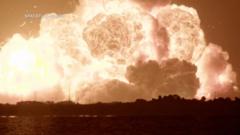
Blue Origin New Glenn Rocket Explodes on Florida Launch Pad
Blue Origin's New Glenn Rocket Explodes on Florida Launch Pad During Engine Test
Blue Origin's New Glenn rocket exploded in a massive fireball on the launch pad at Cape Canaveral Space Force Station in Florida on Thursday night, May 29, 2026, at approximately 9 p.m. ET. The explosion occurred during a pre-launch hot-fire test — a procedure in which rocket engines are ignited while the vehicle remains secured to the ground — and leveled what had been described as one of the most consequential upcoming missions in the company's history. Blue Origin founder Jeff Bezos confirmed the incident via social media, calling it a "very rough day." No injuries were reported.
What Happened: A Static Fire Test Gone Catastrophically Wrong
The New Glenn rocket, which stands 321 feet tall, was undergoing a hot-fire engine test at Launch Complex 36 (LC-36) at Cape Canaveral Space Force Station ahead of a satellite launch planned for the following week. According to Blue Origin's official statement, the test resulted in an anomaly that destroyed the vehicle.
"We experienced an anomaly during today's hotfire test. All personnel have been accounted for," Blue Origin said in an official statement posted to X.
Because static fire tests are typically conducted with a fully fueled rocket, TechCrunch described the resulting explosion as potentially one of the largest rocket explosions in U.S. history and the worst failure in Blue Origin's existence. The launch pad at LC-36 was reported to have been severely damaged. According to Wikipedia's New Glenn article, the first-stage booster — named "No, It's Necessary" — exploded during the test, causing significant damage to the pad infrastructure.
The Federal Aviation Administration confirmed it was aware of the anomaly, but notably stated that the test "was not within the scope of FAA licensed activity." This suggests the hot-fire test was conducted outside of the agency's formal launch licensing framework, a detail that may factor into subsequent regulatory review.
Brevard County Sheriff Wayne Ivey addressed public safety concerns quickly following the explosion. "There is no danger or threat to the community and if any further information develops we will provide an update as it becomes available!!" Ivey said. His office confirmed that the plan was to allow the contained fire from the explosion to burn itself out. Space Force officials also confirmed that the explosion would not affect upcoming launches by other companies from other pads at the facility.

A High-Stakes Mission Destroyed Before It Began
The destroyed mission — designated NG-4 — was far more than a routine launch. According to TechCrunch, it was to be the first of 24 New Glenn launches Amazon has contracted Blue Origin to carry out, with the payload consisting of internet satellites for the Amazon Leo constellation, Amazon's planned broadband satellite network designed to compete with SpaceX's Starlink. Amazon confirmed that no Leo satellites were on board the rocket during the test.
The NG-4 mission was also positioned as a critical stepping stone toward Blue Origin's certification for national security launch missions. The company holds a National Security Space Launch Phase 3 Lane 2 contract awarded by Space Systems Command in April 2025, with an anticipated value of $2.4 billion for approximately seven projected flights.
The timing of the explosion added another layer of significance. Just one day before the disaster, NASA Administrator Jared Isaacman publicly announced that NASA had awarded Blue Origin a $188 million contract to help build a Moon Base as part of the agency's Artemis lunar program — a high-profile vote of confidence that now sits in stark contrast to the wreckage at LC-36.
United Launch Alliance's Atlas V rocket was due to launch the following night, Friday, carrying a separate batch of Amazon Leo satellites — the same type of payload the New Glenn was supposed to carry in the coming week. That mission was expected to proceed from a different pad, unaffected by the explosion.
Context: A Rocket Program Under Pressure
The New Glenn explosion is the latest — and by far the most damaging — setback in what has been a turbulent stretch for Blue Origin's flagship launch vehicle. The rocket made its debut in January 2025, becoming the first commercial rocket to reach orbit on its maiden flight. A second successful mission followed in November 2025, delivering NASA's ESCAPADE Mars probes and achieving the first successful recovery of New Glenn's first-stage booster.
But New Glenn's third flight, in April 2026, ended in a satellite deployment failure when an upper-stage engine malfunction left a payload in the wrong orbit. The FAA grounded the rocket following the incident. On May 22, 2026 — just one week before the NG-4 test — the FAA cleared New Glenn to return to flight following its review of the April 19 anomaly.
Blue Origin CEO Dave Limp had previously indicated the company hoped to achieve at least eight New Glenn launches in 2026 before the NG-3 incident. With the launch pad now severely damaged and the NG-4 vehicle destroyed, that target has been rendered unreachable, and the company's broader 2026 launch cadence is in serious jeopardy.
The explosion represents a significant blow not only to Blue Origin's commercial ambitions but to its standing in the national security and civil space sectors. The $2.4 billion Space Force contract and the newly announced $188 million NASA Moon Base agreement both hinge on the company demonstrating reliable, repeatable access to orbit — something the past two missions have failed to deliver in different ways.
Reactions: Bezos, Isaacman, Musk, and Capitol Hill
Jeff Bezos, who founded Blue Origin, responded publicly on X within hours of the explosion, striking a resolute tone despite the magnitude of the setback.
"Very rough day, but we'll rebuild whatever needs rebuilding and get back to flying. It's worth it," Bezos wrote. He added: "It's too early to know the root cause but we're already working to find it."
NASA Administrator Jared Isaacman, who had praised Blue Origin just 24 hours earlier when announcing the Moon Base contract, responded with measured acknowledgment of the difficulty of spaceflight.
"Spaceflight is unforgiving, and developing new heavy-lift launch capability is extraordinarily difficult," Isaacman wrote on X. He added: "We will work with our partners to support a thorough investigation of this anomaly, assess near-term mission impacts, and get back to launching rockets."
SpaceX CEO Elon Musk — whose Falcon 9 and Starship programs compete directly with New Glenn in multiple market segments — offered brief condolences via X. "Sorry to see this, I hope you recover quickly," Musk wrote, later adding: "Most unfortunate. Rockets are hard."
On Capitol Hill, Rep. Mike Haridopolos (R-FL), whose congressional district includes Cape Canaveral, also weighed in. "I am grateful there were no reported injuries and thankful for the first responders, engineers, and launch crews who acted quickly," Haridopolos said via X.
What Comes Next for Blue Origin and New Glenn
The immediate path forward for Blue Origin is deeply uncertain. The company has confirmed it is already working to determine the root cause of the anomaly, but with the launch pad at LC-36 reported to be severely damaged, the timeline for any return to flight is unclear. Pad repairs, vehicle reconstruction, and a fresh FAA licensing process for future tests and launches will all factor into when — and whether — New Glenn flies again in the near term.
The FAA's statement that the hot-fire test fell outside the scope of licensed activity may also prompt additional regulatory scrutiny of how Blue Origin conducts pre-launch testing, potentially adding procedural steps before the company can resume operations.
For Amazon's Leo constellation program, the explosion introduces an uncertain delay to a launch campaign that had not yet begun. Amazon confirmed no satellites were lost in the explosion, but the broader schedule for deploying its broadband network now faces new questions. The United Launch Alliance Atlas V mission scheduled for the following night offered some continuity for the Leo program in the short term, but Blue Origin's role as a primary launch provider for 24 contracted missions now depends on how quickly the company can recover.
Blue Origin's government contracts — including the Space Force's $2.4 billion national security launch agreement and the newly awarded $188 million NASA Moon Base contract — also face near-term uncertainty, as both programs require demonstrated launch reliability that the NG-4 disaster has put further out of reach.
Jeff Bezos has signaled his intention to press forward. Whether the hardware, the infrastructure, and the institutional momentum can match that intent remains to be seen.
For more tech news, visit our news section.
Why This Matters Beyond the Launchpad
Setbacks in critical infrastructure — whether in aerospace, technology, or logistics — are powerful reminders of how quickly progress can be interrupted and how vital resilience is, both for organizations and individuals. The same discipline that keeps engineers focused after a catastrophic failure — identifying root causes, iterating systematically, and maintaining long-term perspective — is the foundation of sustainable performance in any field. At Moccet, we believe building that kind of resilience is a daily practice, not a crisis response. Join the Moccet waitlist to stay ahead of the curve.