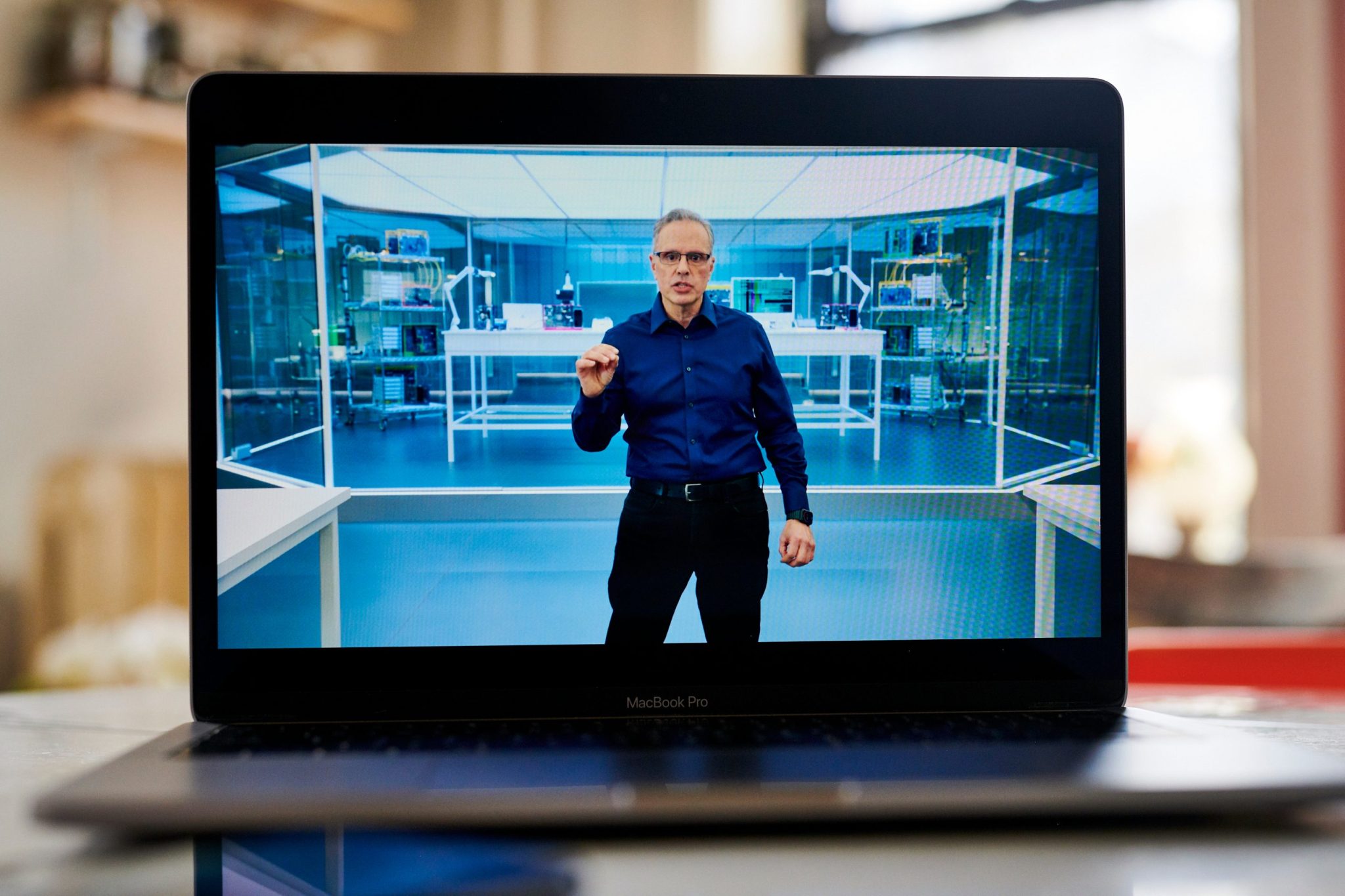
Apple rocked by executive departures, with chip chief at risk of leaving next
```json { "title": "Apple Executive Exodus: From Chip Crisis to CEO Succession", "metaDescription": "Apple's biggest leadership shake-up in decades — from Johny Srouji's near-departure to Tim Cook stepping down as CEO in September 2026. Here's what happened.", "content": "<h2>Apple's Executive Exodus Reshapes One of Silicon Valley's Most Stable Companies</h2><p>In the span of just a few months, Apple — long regarded as one of the most leadership-stable companies in the technology industry — experienced its most significant executive shake-up in decades. Beginning in late 2025 and culminating in a formal CEO succession announcement in April 2026, the company watched a wave of senior departures ripple through its upper ranks, raise urgent questions about its competitive position in artificial intelligence, and ultimately force a reckoning at the very top of the org chart.</p><p>At the center of the storm was Johny Srouji, Apple's senior vice president of hardware technologies and the architect of the company's celebrated transition to custom silicon. According to Bloomberg, Srouji told CEO Tim Cook in early December 2025 that he was seriously considering leaving the company in the near future — a disclosure that, if acted upon, would have represented one of the most consequential departures in Apple's modern history. Cook moved aggressively to retain him. As of April 20, 2026, Srouji is not only still at Apple — he has been elevated to a newly created role as Chief Hardware Officer, a central figure in the company's next chapter.</p><h2>A Wave of Departures: Who Left Apple and Where They Went</h2><p>The Srouji situation did not emerge in isolation. According to Fortune, in just one week in early December 2025, Apple's heads of artificial intelligence and interface design stepped down, and the company also announced that its general counsel and head of governmental affairs were leaving — all four of whom reported directly to Tim Cook.</p><p>The departures, taken together, painted a striking picture. John Giannandrea, Apple's AI chief, began being phased out of his role in March 2025, though he was being allowed to remain until the following spring. Alan Dye, a design veteran who had shaped Apple's software interfaces for years, left to join Meta's Reality Labs unit. On the legal and policy side, Apple's official press release confirmed that general counsel Kate Adams — who had served in that role since 2017 — would be succeeded by Jennifer Newstead on March 1, 2026. Lisa Jackson, vice president for Environment, Policy, and Social Initiatives, retired in late January 2026.</p><p>The talent drain extended deep into Apple's technical core. According to TechCrunch, former head of AI models Ruoming Pang and Ke Yang — the executive leading Apple's work on AI-driven web search — both left for Meta. According to MacRumors, Cheng Chen, a key director overseeing display technologies and the optics of the Vision Pro headset, departed for OpenAI, as did top hardware engineering executive Tang Tan. Apple was, in effect, seeding its most formidable competitors with some of its most experienced technical talent.</p><p>The departures were not limited to technical and legal roles. According to Fortune, CFO Luca Maestri stepped into a smaller role at the start of 2025 and is considered likely to retire in the not-too-distant future. Jeff Williams, who had served as Apple's chief operating officer for a decade, retired from that role as well. The cumulative effect was an Apple leadership structure that looked markedly different from the one that had guided the company through its rise to a $4 trillion market capitalization.</p><h2>Srouji at the Center: Near-Departure, Public Denial, and Elevation</h2><p>Of all the departures and near-departures, the Srouji situation drew the most intense attention — and for good reason. Having joined Apple in 2008 and been promoted to senior vice president of hardware technologies in 2015, according to MacRumors, Srouji oversaw the development of the company's custom silicon — a strategic transformation that has been widely credited with giving Apple a decisive hardware advantage over its competitors.</p><p>According to Bloomberg's Mark Gurman, Cook worked aggressively to retain Srouji, offering a substantial pay package and floating the possibility of more responsibility. One scenario discussed internally involved elevating Srouji to the role of chief technology officer, which would have made him Apple's second-most-powerful executive. Bloomberg also reported that if Srouji did ultimately depart, Apple would likely look to one of his two top lieutenants — Zongjian Chen or Sribalan Santhanam — to replace him.</p><p>Srouji moved quickly to address the speculation publicly. According to CNBC, he sent a memo to staff on December 8, 2025, stating clearly: <strong>"I love my team, and I love my job at Apple, and I don't plan on leaving anytime soon."</strong></p><p>That memo proved to be more than a reassurance — it foreshadowed what came next. According to MacRumors, on April 20, 2026, Apple announced that Tim Cook would step down as CEO on September 1, 2026, transitioning to an active role as executive chairman. John Ternus, the hardware engineering chief long considered a leading candidate for the top job, was named Cook's successor. As part of that transition, Srouji was elevated to the newly created role of Chief Hardware Officer, combining oversight of both hardware engineering and silicon technologies under his leadership.</p><h2>The AI Competitiveness Question Looming Behind the Departures</h2><p>The executive churn did not occur in a vacuum. It unfolded against a backdrop of growing concern — both inside Apple and among outside observers — about the company's standing in artificial intelligence. Apple's Siri overhaul was reported to be running significantly behind schedule, and the company's Apple Intelligence platform faced criticism over delayed features and underwhelming execution. The departure of Giannandrea, Pang, Yang, and other AI-adjacent leaders to Meta and OpenAI only amplified those concerns.</p><p>Apple remained, by most financial measures, extraordinarily strong. According to CNN, citing Counterpoint Research, Apple was expected to surpass Samsung in global smartphone shipments in 2025 for the first time since 2011. The company is among a small group — alongside Nvidia and Microsoft — to have crossed the $4 trillion market capitalization threshold. Apple stock was up roughly 12% in 2025, according to data cited by IndexBox, though that lagged the 30% increase the stock recorded in 2024.</p><p>The AI talent exodus, nonetheless, represented a structural challenge that financial metrics alone could not fully capture. The executives who left for Meta and OpenAI did not take stock options with them — they took institutional knowledge, technical expertise, and years of experience building Apple's most forward-looking systems.</p><h2>Expert Reactions</h2><p>The scale and speed of Apple's leadership changes prompted pointed commentary from market analysts and technology observers.</p><p>Dan Ives, Global Head of Tech Research at Wedbush Securities, offered a frank assessment of the succession announcement: <strong>"This is against the typical culture of Apple. But they need to rip the Band-Aid off."</strong></p><p>Robert Siegel, a venture capitalist and lecturer at Stanford's Graduate School of Business, was measured but direct about the broader implications: <strong>"The only thing we can read into this is that we're headed to a time of increased volatility for Apple."</strong></p><p>Both observations reflect a genuine tension at the heart of Apple's current moment: the company's institutional culture has historically prized stability and opacity, yet the events of the past several months have been anything but stable or opaque.</p><h2>What Comes Next for Apple's Leadership</h2><p>With Tim Cook's departure from the CEO role set for September 1, 2026, Apple now faces the challenge of executing one of the most scrutinized leadership transitions in corporate history. John Ternus will inherit a company with unmatched brand loyalty, a hardware ecosystem that remains the envy of the industry, and a silicon platform — now overseen by Srouji as Chief Hardware Officer — that continues to set benchmarks for performance and efficiency.</p><p>But Ternus will also inherit unresolved questions. Apple's AI roadmap remains a work in progress, with key technical talent now working for rivals. The executive team around him will be substantially newer and less seasoned than the one that guided Apple through its decade-long ascent. And the market will be watching closely to see whether the company's culture of disciplined, long-horizon product development survives the transition intact.</p><p>Srouji's elevation to Chief Hardware Officer does provide one clear signal of continuity: the silicon advantage that Apple has built over the past decade — the engine behind the iPhone, the Mac, and the Vision Pro — will remain under the stewardship of the executive who built it. Whether that is enough to steady the ship through a period of genuine institutional flux remains to be seen.</p><p>For more tech news, visit our <a href="/news">news section</a>.</p>", "excerpt": "Apple's most significant leadership shake-up in decades — spanning AI talent losses to Meta and OpenAI, the near-departure of chip chief Johny Srouji, and Tim Cook's planned exit as CEO — is reshaping the company's future. Here's a full account of what happened and what it means.", "keywords": ["Apple executive departures", "Johny Srouji Chief Hardware Officer", "Tim Cook succession", "John Ternus Apple CEO", "Apple leadership 2026"], "slug": "apple-executive-exodus-chip-chief-ceo-succession-2026" } ```